标准信息
STANDARD INFORMATION- 标准编号
- ACI 306R-88
- 所属分类
- ACI 美国混凝土学会标准
- 发布机构
- American Concrete Institute (ACI)
- 版本年份
- 1997
- 文件语言
- 英语
- 文件格式
- 文件页数
- 6 页
- 文件大小
- 364.88 KB
中文名称为参考译名,文件语言以原文为准。
· 更新:
标准简介
OVERVIEW中文简介
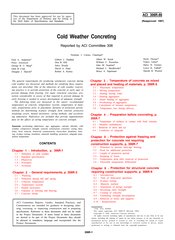
该标准规定了寒冷天气条件下生产合格混凝土的一般要求,并描述了满足这些要求的方法。其适用范围包括混凝土温度控制、材料温度、浇筑前准备、保护期、强度测定、模板拆除、保温覆盖、加热围护、养护方法和加速外加剂等内容。
English summary
This report discusses general requirements for producing satisfactory concrete in cold weather and describes methods for meeting them. It covers concrete temperature control, material temperatures, preparation before placement, protection duration, in-place strength determination, form removal, insulating covers, heated enclosures, curing methods, and accelerating admixtures.
以上为根据文件整理的内容简介。
相关标签
标准内容预览
DOCUMENT PREVIEW我们需要回答用户:作为OCR引擎,把工程标准PDF页面精确转成HTML片段,只返回HTML,不要解释。需要遵守严格标签/class限制。现在分析页面内容。
页面是 306R-2 MANUAL OF CONCRETE PRACTICE 页眉忽略。页码底部? 页面没有明显页码?示例要求每页输出必须以
开头,页码用
2
结尾。这里页眉有 306R-2,但页码由2占位符生成,结尾必须2
。开头必须 h2。页面内标题?有 CHAPTER 1 - INTRODUCTION 等。最高优先级说每页输出必须以 开头(页面内标题)。页面顶部有 Chapter 7... 等目录列表,红色。然后 CHAPTER 1 - INTRODUCTION。应该以 h2 开头,可能用 Chapter 7 - Materials and methods of protection, p. 306R-13
? 但页面内标题?页面顶部是章节列表,不是正文标题?要求每页输出必须以 h2 开头(页面内标题)。可以用第一个可见标题作为 h2。页面有 CHAPTER 1 - INTRODUCTION 是正文标题。但顶部 Chapter 7... 也是标题/目录。为了以 h2 开头,可以 Chapter 7 - Materials and methods of protection, p. 306R-13
然后列表?但列表是目录项,可能用 p 或 ul? 允许 ul/li 无属性。编号体系保留。红色章节列表可转成 p 或 ul。由于是目录,用
每行?但连续行。也可用
- 但 li 无属性。编号 7.1 等保留。
需要忠实还原。两栏布局:页面明显两栏。可用 table class="layout-columns" with tr td left/right. 但内容跨栏复杂:左栏包含 Chapter 7-10 目录、CHAPTER 1、1.1、1.2、1.3、1.3.1 开始;右栏包含 1.3.1 继续、1.3.2-1.3.5、1.4、1.4.1、1.4.2。还有脚注在左栏底部。两栏布局用 table class="layout-columns" 是推荐。但表格内可以包含 p, h2? 允许 table td 内任意允许标签?应该可以。每页输出必须以 h2 开头,如果整个页面用 table,第一个元素是 table,不满足以 h2 开头。可以先放 h2 再 table? 但两栏布局包含 h2? 要求每页输出必须以
开头,可以 Chapter 7 - Materials and methods of protection, p. 306R-13
然后 table layout-columns 包含其余。或者 CHAPTER 1 - INTRODUCTION
然后 table? 但顶部目录在 h2 前?如果 h2 是 CHAPTER 1,则顶部目录不能在其前。也许把顶部目录作为 h2? 但 CHAPTER 1 也是 h2/h3。
需要满足“每页输出必须以
开头(页面内标题)”。可以输出:
Chapter 7 - Materials and methods of protection, p. 306R-13
7.1 - Introduction
...Chapter 8 ...
...
CHAPTER 1 - INTRODUCTION
...
2
这满足以 h2 开头。是否页面内标题?顶部 Chapter 7 是标题。可以。
但两栏布局:如果不用 table,按阅读顺序左栏然后右栏? OCR 精确转 HTML 片段,可能保留两栏用 layout-columns。但复杂跨栏段落:1.3.1 从左栏底部继续到右栏顶部。如果用两栏 table,左栏包含到“decreases”,右栏包含“as the concrete gains maturity...”。这样更忠实视觉。但开头 h2 在 table 外?可以:
Chapter 7 - Materials and methods of protection, p. 306R-13
| ... left ... | ... right ... |
2
但左栏包含多个 h2? 允许 td 内 h2? 标签允许。但页面内标题层级:Chapter 7 等可能 h2,CHAPTER 1 也 h2? 可以。
但“每页输出必须以
开头”如果 table 前有 h2,满足。
需要避免 style, nbsp, 连续空格。用普通空格。
内容细节:
页眉:306R-2 MANUAL OF CONCRETE PRACTICE 忽略。
左栏:
Chapter 7 - Materials and methods of protection, p. 306R-13
7.1 - Introduction
7.2 - Insulating materials
7.3 - Selection of insulation
7.4 - Enclosures
7.5 - Internal electric heating
7.6 - Covering after placement
7.7 - Temporary removal of protection
7.8 - Insulated forms
Chapter 8 - Curing requirements and methods, p. 306R-20
8.1 - Introduction
8.2 - Curing during the protection period
8.3 - Curing following the protection period
Chapter 9 - Acceleration of setting and strength development, p. 306R-21
9.1 - Introduction
9.2 - Calcium chloride as an accelerating admixture
9.3 - Other accelerating admixtures
Chapter 10 - References, p. 306R-22
10.1 - Recommended references
10.2 - Cited references
10.3 - Selected references
CHAPTER 1 - INTRODUCTION
1.1 - Definition of cold weather
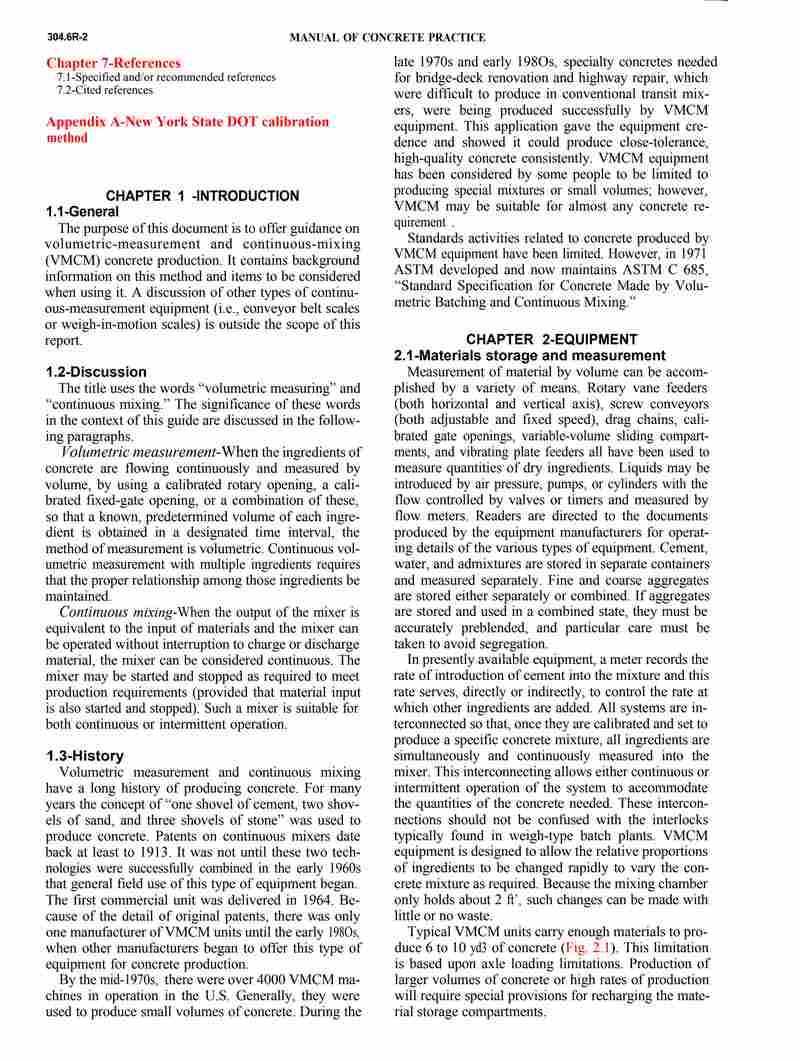
This report describes construction procedures which, if properly followed, can result in concrete placed in cold weather of sufficient strength and durability to satisfy intended service requirements. Concrete placed during cold weather will develop these qualities only if it is properly produced, placed, and protected. The necessary degree of protection increases as the ambient temperature decreases.
Cold weather is defined as a period when, for more than 3 consecutive days, the following conditions exist:
1) the average daily air temperature is less than 40 F (5 C) and the air temperature is not greater than 50 F (10 C) for more than one-half of any 24-hr period.*
The average daily air temperature is the average of the highest and the lowest temperatures occurring during the period from midnight to midnight. Cold weather, as defined in this report, usually starts during fall and usually continues until spring.
1.2 - Standard specification
If requirements for cold weather concreting are needed in specification form, ACI 306.1 should be referenced; if necessary, appropriate modifications should be added to the contract documents after consulting the specification checklist.
1.3 - Objectives
The objectives of cold weather concreting practices are to:
1.3.1 - prevent damage to concrete due to freezing at early ages. When no external water is available, the degree of saturation of newly placed concrete decreases
右栏继续:
as the concrete gains maturity and the mixing water combines with cement during hydration. Under such conditions, the degree of saturation falls below the critical level (the degree of water saturation where a single cycle of freezing would cause damage) at approximately the time that the concrete attains a compressive strength of 500 psi (3.5 MPa) (Powers 1962). At 50 F (10 C), most well-proportioned concrete mixtures reach this strength during the second day.
1.3.2 - assure that the concrete develops the required strength for safe removal of forms, for safe removal of shores and reshores, and for safe loading of the structure during and after construction.
1.3.3 - maintain curing conditions that foster normal strength development without using excessive heat and without causing critical saturation of the concrete at the end of the protection period.
1.3.4 - limit rapid temperature changes, particularly before the concrete has developed sufficient strength to withstand induced thermal stresses. Rapid cooling of concrete surfaces or large temperature differences between exterior and interior members of the structure can cause cracking, which can be detrimental to strength and durability. At the end of the required period, insulation or other means of protection should be removed gradually so that the surface temperature decreases gradually during the subsequent 24-hr period (see Section 5.5).
1.3.5 - provide protection consistent with the intended serviceability of the structure. Concrete structures are intended for a useful life of many years. The attainment of satisfactory strength for 28-day, standard-cured cylinders is irrelevant if the structure has corners damaged by freezing; dehydrated areas; and cracking from overheating because of inadequate protection, improper curing, or careless workmanship. Similarly, early concrete strength achieved by indiscriminate use of excessive calcium chloride is of no avail if the concrete becomes excessively cracked in later years because of the likelihood of disruptive internal expansion due to alkali-aggregate reaction or of possible corrosion of reinforcement (see Section 9.2). Short-term construction economy should not be obtained at the expense of long-term durability.
1.4 - Principles
This report presents recommendations to achieve the objectives listed in Section 1.3 (Schnarr and Young 1934a and 1934b). The practices and procedures described in this report stem from the following principles concerning cold weather concreting:
1.4.1 - Concrete that is protected from freezing until it has attained a compressive strength of at least 500 psi (3.5 MPa) will not be damaged by exposure to a single freezing cycle (Powers 1962).
1.4.2 - Concrete that is protected as in Section 1.4.1 will mature to its potential strength despite subsequent exposure to cold weather (Malhotra and Berwanger 1973). No further protection is necessary unless a certain strength must be attained in less time.
脚注左栏底部:
*The values in SI units are direct conversions of the in-lb values. They do not necessarily represent common metric ranges or sizes. For practical application, the user should adjust them to conform with local practice.
注意原文是 in-lb? 可能 in-lb values? 图中 "in-lb values" maybe in-lb? It says in-lb values. Keep.
需要处理 Section 5.5, Section 9.2 可能红色链接,但无 a。保留文本。
编号体系:1.3.1 等。列表 1) 可以保留为 p 或 ol? 禁止 ol/ul/li 带属性,但可以用 ol/li 无属性。原文有 1) 编号,若用 ol 会生成自动编号,可能改变原文?要求编号体系必须保留。最好用
1) ...
保留原文。不要使用 ol 因为可能不保留 1) 文本?如果用 ol 无属性,li 文本不含 1),编号由浏览器生成,但 HTML 片段可能不显示?要求保留编号,最好文本保留。目录项:可用
7.1 - Introduction
等。章节标题用 h2/h3? 顶部 Chapter 7 等是标题,可用 h2。CHAPTER 1 用 h2。子标题 1.1 用 h3? 页面内标题层级:Chapter 7 是 h2, 1.1 是 h3? 但 CHAPTER 1 也是 h2. 可以。两栏 table: 如果左栏包含 h2 Chapter 7... 和 CHAPTER 1... 等,右栏包含继续段落。但 table 内 h2 可能影响“每页输出必须以 h2 开头”? table 前有 h2 即可。
但 table class="layout-columns" 示例是
| 左栏 | 右栏 |
是否允许 table 内包含多个 p/h2? 应该允许。
但“每页输出必须以
开头(页面内标题)”如果先 h2 Chapter 7,然后 table 内又 h2 Chapter 7? 重复同一段文字禁止。不要重复。所以如果 table 外 h2 是 Chapter 7,table 内左栏不应再包含 Chapter 7 标题。但左栏视觉包含 Chapter 7 标题。若 table 外 h2 提取出来,左栏从 7.1 开始。这样不重复。但 CHAPTER 1 标题在左栏内,可以 h2。这样页面开头 h2 是 Chapter 7。是否合理?页面内标题第一个是 Chapter 7。可以。
或者不用两栏 table,按线性顺序:h2 Chapter 7, p 7.1..., h2 Chapter 8..., h2 Chapter 9..., h2 Chapter 10..., h2 CHAPTER 1..., h3 1.1..., p..., h3 1.2..., h3 1.3..., p 1.3.1 left, p right continuation, etc. 这更简单,满足以 h2 开头。是否必须两栏布局?排版替代方案说两栏布局 → table class="layout-columns"。不是强制?但页面是两栏,最好用 layout-columns。但复杂跨栏段落可能用 table 更忠实。
考虑输出长度和正确性。用两栏 table 可能更复杂但可行。需要确保标签闭合。
方案 A: 线性输出,不用 table。可能被认为未保留两栏布局?规则说排版替代方案(不要自己发明):两栏布局 → table class="layout-columns"。如果页面明显两栏,应该使用。但 OCR 转 HTML 片段,不一定必须保留栏,但“精确转成HTML片段”可能希望保留。使用 table 更安全。
但 table 内包含 h2 和 p,且跨栏段落分割。需要处理脚注位置:脚注在左栏底部,按原文位置输出为 small-note。在 table 左栏最后放
...
。右栏最后放 1.4.2。开头 h2 在 table 外:
Chapter 7 - Materials and methods of protection, p. 306R-13
|
7.1 - Introduction ... Chapter 8 - Curing requirements and methods, p. 306R-20... CHAPTER 1 - INTRODUCTION1.1 - Definition of cold weather... ... 1) ... ... 1.2 - Standard specification... 1.3 - ObjectivesThe objectives ... 1.3.1 - prevent damage ... decreases *The values ... |
as the concrete gains maturity ... 1.3.2 - assure ... ... 1.4 - Principles... 1.4.1 - ... 1.4.2 - ... |
2
But table 内 h2 Chapter 8 etc. Is h2 inside td okay? Yes. But page output starts with h2 outside. Good.
Potential issue: table class layout-columns with h2 inside td may be considered not page title? okay.
But if h2 outside is Chapter 7, then table left starts with 7.1. Good.
Need preserve red chapter headings? No color. Use h2.
Need preserve line breaks? Paragraphs. For list of subitems, each p. Could use
for subitems? Original subitems indented under chapter. Could use indent class. But not necessary? It says indent → p class="indent". To preserve visual indentation, use indent for 7.1 etc? They are indented relative to chapter. Could use
7.1 - Introduction
. But many. Allowed. For numbered paragraphs 1.3.1 etc maybe indent? They are indented. Could use indent. But not required. Use indent for subitems to reflect. But avoid overdoing? It's okay.Need ensure no consecutive spaces. Use single spaces.
Need handle hyphenation? Original line breaks not needed. Keep words.
Need exact text: "Chapter 7 - Materials and methods of protection, p. 306R-13". "Chapter 8 - Curing requirements and methods, p. 306R-20". "Chapter 9 - Acceleration of setting and strength development, p. 306R-21". "Chapter 10 - References, p. 306R-22".
Subitems:
7.1 - Introduction
7.2 - Insulating materials
7.3 - Selection of insulation
7.4 - Enclosures
7.5 - Internal electric heating
7.6 - Covering after placement
7.7 - Temporary removal of protection
7.8 - Insulated forms
8.1 - Introduction
8.2 - Curing during the protection period
8.3 - Curing following the protection period
9.1 - Introduction
9.2 - Calcium chloride as an accelerating admixture
9.3 - Other accelerating admixtures
10.1 - Recommended references
10.2 - Cited references
10.3 - Selected references
CHAPTER 1 - INTRODUCTION
1.1 - Definition of cold weather
Paragraphs:
"This report describes construction procedures which, if properly followed, can result in concrete placed in cold weather of sufficient strength and durability to satisfy intended service requirements. Concrete placed during cold weather will develop these qualities only if it is properly produced, placed, and protected. The necessary degree of protection increases as the ambient temperature decreases."
"Cold weather is defined as a period when, for more than 3 consecutive days, the following conditions exist:"
"1) the average daily air temperature is less than 40 F (5 C) and the air temperature is not greater than 50 F (10 C) for more than one-half of any 24-hr period.*"
"The average daily air temperature is the average of the highest and the lowest temperatures occurring during the period from midnight to midnight. Cold weather, as defined in this report, usually starts during fall and usually continues until spring."
1.2 - Standard specification
"If requirements for cold weather concreting are needed in specification form, ACI 306.1 should be referenced; if necessary, appropriate modifications should be added to the contract documents after consulting the specification checklist."
1.3 - Objectives
"The objectives of cold weather concreting practices are to:"
"1.3.1 - prevent damage to concrete due to freezing at early ages. When no external water is available, the degree of saturation of newly placed concrete decreases"
Right:
"as the concrete gains maturity and the mixing water combines with cement during hydration. Under such conditions, the degree of saturation falls below the critical level (the degree of water saturation where a single cycle of freezing would cause damage) at approximately the time that the concrete attains a compressive strength of 500 psi (3.5 MPa) (Powers 1962). At 50 F (10 C), most well-proportioned concrete mixtures reach this strength during the second day."
"1.3.2 - assure that the concrete develops the required strength for safe removal of forms, for safe removal of shores and reshores, and for safe loading of the structure during and after construction."
"1.3.3 - maintain curing conditions that foster normal strength development without using excessive heat and without causing critical saturation of the concrete at the end of the protection period."
"1.3.4 - limit rapid temperature changes, particularly before the concrete has developed sufficient strength to withstand induced thermal stresses. Rapid cooling of concrete surfaces or large temperature differences between exterior and interior members of the structure can cause cracking, which can be detrimental to strength and durability. At the end of the required period, insulation or other means of protection should be removed gradually so that the surface temperature decreases gradually during the subsequent 24-hr period (see Section 5.5)."
"1.3.5 - provide protection consistent with the intended serviceability of the structure. Concrete structures are intended for a useful life of many years. The attainment of satisfactory strength for 28-day, standard-cured cylinders is irrelevant if the structure has corners damaged by freezing; dehydrated areas; and cracking from overheating because of inadequate protection, improper curing, or careless workmanship. Similarly, early concrete strength achieved by indiscriminate use of excessive calcium chloride is of no avail if the concrete becomes excessively cracked in later years because of the likelihood of disruptive internal expansion due to alkali-aggregate reaction or of possible corrosion of reinforcement (see Section 9.2). Short-term construction economy should not be obtained at the expense of long-term durability."
1.4 - Principles
"This report presents recommendations to achieve the objectives listed in Section 1.3 (Schnarr and Young 1934a and 1934b). The practices and procedures described in this report stem from the following principles concerning cold weather concreting:"
"1.4.1 - Concrete that is protected from freezing until it has attained a compressive strength of at least 500 psi (3.5 MPa) will not be damaged by exposure to a single freezing cycle (Powers 1962)."
"1.4.2 - Concrete that is protected as in Section 1.4.1 will mature to its potential strength despite subsequent exposure to cold weather (Malhotra and Berwanger 1973). No further protection is necessary unless a certain strength must be attained in less time."
Footnote:
"*The values in SI units are direct conversions of the in-lb values. They do not necessarily represent common metric ranges or sizes. For practical application, the user should adjust them to conform with local practice."
Check "in-lb" maybe "in-lb" yes. Could be "in-lb values" from SI conversion? It might be "in-lb" but context temperature? Actually footnote: "The values in SI units are direct conversions of the in-lb values." Maybe "in-lb" is inch-pound? Yes.
Need maybe use for inline formula? No formulas.
Need maybe use for headings? No, headings enough.
Need no style. No nbsp. No Markdown. Potential issue: table class layout-columns with td containing h2 may be invalid? HTML allows headings in td. Good. Potential issue: "每页输出必须以 Potential issue: "页码用 2 Potential issue: "禁止 h1、div..." We use table, tr, td, p, h2, h3, span? no. Potential issue: "只允许 td/th 带 rowspan/colspan" We don't use. Potential issue: "禁止 ol/ul/li 带任何属性" We don't use. Potential issue: "不要输出无意义的空白字符" We can include newlines for readability? It says no meaningless whitespace? Newlines between tags okay? Probably okay. But to be safe, output compact with newlines? Newlines are whitespace but not meaningless? They may be okay. But "不要输出无意义的空白字符" maybe avoid extra blank lines. We can output with line breaks between tags. Fine. Need decide whether to use table layout. If table, the first h2 outside is Chapter 7. But then left td starts with 7.1. The visual left column includes Chapter 7 heading; we moved it outside. That's okay but not exactly two-column? The heading spans left column only, not full width. But output starts with h2. Could instead put h2 inside left td and no outside h2? Violates start. Could put h2 outside as page title "CHAPTER 1 - INTRODUCTION"? But then top Chapter 7 list before? Can't. Could put h2 outside as "Chapter 7 - Materials and methods of protection, p. 306R-13". Good. But if h2 outside, then table left column begins with 7.1, but the Chapter 7 heading is not in left column visually. Acceptable? Maybe. Alternative: Use linear output with h2 Chapter 7, then all content. Simpler and avoids table complexity. But two-column layout rule? It says 排版替代方案(不要自己发明): 两栏布局 → table class="layout-columns". If we don't use table, are we inventing? Not necessarily, but page is two-column. To be safe, use table. Need ensure table has no caption? Not needed. Could use 开头(页面内标题)" If we output h2 outside then table, okay. But if table contains h2 Chapter 8 etc, multiple h2. okay.
. Allowed tbody. Good.... ...
Need maybe include
for subitems. Use indent for 7.1 etc and 1.3.1 etc? It may be okay. But if too many indent, still allowed. Use indent for subitems under chapter and numbered clauses? Original 1.3.1 is indented. Use indent.
But if we use indent for 1.3.1 left and right continuation? Right continuation is not indented? It is continuation paragraph, no indent. Use p.
Need preserve asterisk footnote marker in paragraph: period.* no space. Good.
Need maybe use for footnote marker? Not necessary.
Need check "Section 5.5" and "Section 9.2" maybe red, but plain. Need maybe use for "CHAPTER 1 - INTRODUCTION"? It is bold. Headings imply. Could use Need maybe use Need maybe use Potential issue: The top Chapter 7 heading outside h2, then inside table left there is no Chapter 7 heading. But Chapter 8/9/10 headings inside left. Good. Could instead make outside h2 "Chapter 7 - Materials and methods of protection, p. 306R-13" and then table left includes 7.1... etc. Good. Need maybe include page header? Ignore. Need maybe include "306R-2" as page number? It's header, ignore. Page number placeholder 2 at end. Need maybe include "MANUAL OF CONCRETE PRACTICE" header? Ignore. Need maybe include "CHAPTER 1 - INTRODUCTION" as h2 inside left. Good. Let's draft HTML. Potential problem: table class layout-columns with td containing h2 and p may cause the first h2 outside not part of table. Good. Need ensure no Need no continuous two spaces. Check text: "p. 306R-13" single. "40 F (5 C)" single. "50 F (10 C)" single. "24-hr period.*" no double. Need maybe use "1) the average..." with single space after 1). Good. Need maybe preserve line "1.3.1 - prevent damage..." with hyphen. Good. Need maybe preserve "1.3.2 - assure" lower-case. Good. Need maybe preserve "1.3.3 - maintain". Good. Need maybe preserve "1.3.4 - limit". Good. Need maybe preserve "1.3.5 - provide". Good. Need maybe preserve "1.4.1 - Concrete". Good. Need maybe preserve "1.4.2 - Concrete". Good. Need maybe preserve "Schnarr and Young 1934a and 1934b". Good. Need maybe preserve "Malhotra and Berwanger 1973". Good. Need maybe preserve "Powers 1962". Good. Need maybe preserve "ACI 306.1". Good. Need maybe preserve "28-day, standard-cured". Good. Need maybe preserve "well-proportioned". Good. Need maybe preserve "serviceability". Good. Need maybe preserve "dehydrated areas; and cracking". Good. Need maybe preserve "alkali-aggregate". Good. Need maybe preserve "in-lb". Good. Could use for footnote. Good. Need maybe footnote position: It appears at bottom of left column, after 1.3.1 left paragraph. In table left, place after 1.3.1 paragraph. Good. Need maybe right column starts with continuation of 1.3.1. Good. Potential issue: The footnote marker * is in left column paragraph, footnote at bottom left. Good. Potential issue: If table left column has footnote after 1.3.1, but right column has continuation, visually footnote is below left column, not after right. Good. Potential issue: The table layout may not preserve reading order for screen readers, but okay. Need maybe include Let's consider if using h2 inside table violates "每页输出必须以 Need maybe output only HTML fragment, no explanation. Final should be HTML. Double-check allowed class: layout-columns, indent, small-note, align-center. Good. Need maybe not use class on table? allowed. Good. Need maybe not use class on p? allowed. Good. Potential issue: "只允许这些 class(小写,单值)" means each class attribute single value. We use single. Good. Potential issue: "禁止所有 style 属性" none. Potential issue: "禁止 、 、制表符、连续两个以上空格" none. Potential issue: "禁止 Markdown 围栏" none. Potential issue: "禁止 h1..." none. Potential issue: "禁止 ol/ul/li 带任何属性" none. Potential issue: "只允许 td/th 带 rowspan/colspan" none. Potential issue: "每页输出必须以 2 Potential issue: "pre 内只能包含 code" none. Potential issue: "标签必须正确闭合" yes. Need maybe include Let's produce final. But before final, think if there is a better way to satisfy page title. The first visible heading is "Chapter 7 - Materials and methods of protection, p. 306R-13". We use h2. Good. Could there be a requirement "页面内标题:第1页用 h2,后续页用 h2 或 h3(根据视觉层级)" This page likely page 2? But they say page number placeholder 2. It might be page 2 of document? The page header 306R-2 maybe page number? Actually 306R-2 is page number? It is page 2 of report? The page number by 2 placeholder. The page content starts with Chapter 7 list. The main section CHAPTER 1. Use h2 for chapter headings. Good. Need maybe use h3 for Chapter 7? Since page starts with chapter list, maybe h2. Good. Potential issue: The top chapter list is not a heading but a table of contents. But using h2 for each chapter is okay. Potential issue: The line "Chapter 7 - Materials and methods of protection, p. 306R-13" is red and bold. h2. Good. Potential issue: The subitems are red, but no color. Good. Potential issue: The footnote is small note. Good. Potential issue: The right column paragraph "as the concrete gains maturity..." is continuation of 1.3.1. Should it be part of same p? Since split across columns, we can separate p. It's okay. Could use ? No. Potential issue: The left column paragraph "1.3.1 - prevent damage..." ends with "decreases" and right continues. If separate p, okay. Potential issue: The table layout with left td containing many h2 may make the table very tall. okay. Need maybe include all content in table? The first h2 outside not in table. Good. Let's ensure no accidental double spaces after line breaks? In final, line breaks are whitespace but not consecutive spaces? Newline between tags is one whitespace. Fine. But if we indent HTML with spaces, those are leading spaces before tags, maybe considered meaningless whitespace? The rule says no meaningless whitespace characters. To be safe, output without indentation? But readability not required. We can output compact with newlines only between tags, no leading spaces. Newlines are whitespace but necessary? Could be okay. To minimize, output one line? Very long. But no consecutive spaces. We can output with newlines and no indentation. Newlines are not spaces? They are whitespace. "制表符" forbidden, not newline. "连续两个以上空格" forbidden. Newlines okay. But "不要输出无意义的空白字符" maybe newlines between block tags are okay. We'll output with newlines, no indentation. Need check if any text has double spaces due to line wrap? We'll manually ensure single. Draft: 7.1 - Introduction ... ... This report... Cold weather... 1) the average... The average... If requirements... The objectives... 1.3.1 - prevent damage... decreases *The values... as the concrete... 1.3.2 - assure... ... This report... 1.4.1 - Concrete... 1.4.2 - Concrete... 2 Should 1.3.2 etc be indent? Original they are indented under 1.3. Use indent. Good. Should 1.4.1/1.4.2 indent? yes. Should 1.1/1.2/1.3 headings indent? no. Should 7.1 etc indent? yes. Should 8.1 etc indent? yes. Should 9.1 etc indent? yes. Should 10.1 etc indent? yes. Potential issue: The top Chapter 7 heading outside, then 7.1 indent. Good. Need maybe include Chapter 7 subitems before Chapter 8. Good. Let's ensure all text exact. Left: 7.1 - Introduction 7.2 - Insulating materials 7.3 - Selection of insulation 7.4 - Enclosures 7.5 - Internal electric heatingCHAPTER 1 - INTRODUCTION
. Good.
for 1.1 etc. Good.
for Chapter 8 etc inside td. Good.
. Use separate p. 开头"? No, first tag is h2. Good.
开头(页面内标题),页码用
without thead? okay.
Chapter 7 - Materials and methods of protection, p. 306R-13
Chapter 8 - Curing requirements and methods, p. 306R-20
CHAPTER 1 - INTRODUCTION
1.1 - Definition of cold weather
1.2 - Standard specification
1.3 - Objectives
1.4 - Principles
预览内容由文件识别整理,表格、公式及文字请以原始文件为准。
原文图片预览
PAGE IMAGES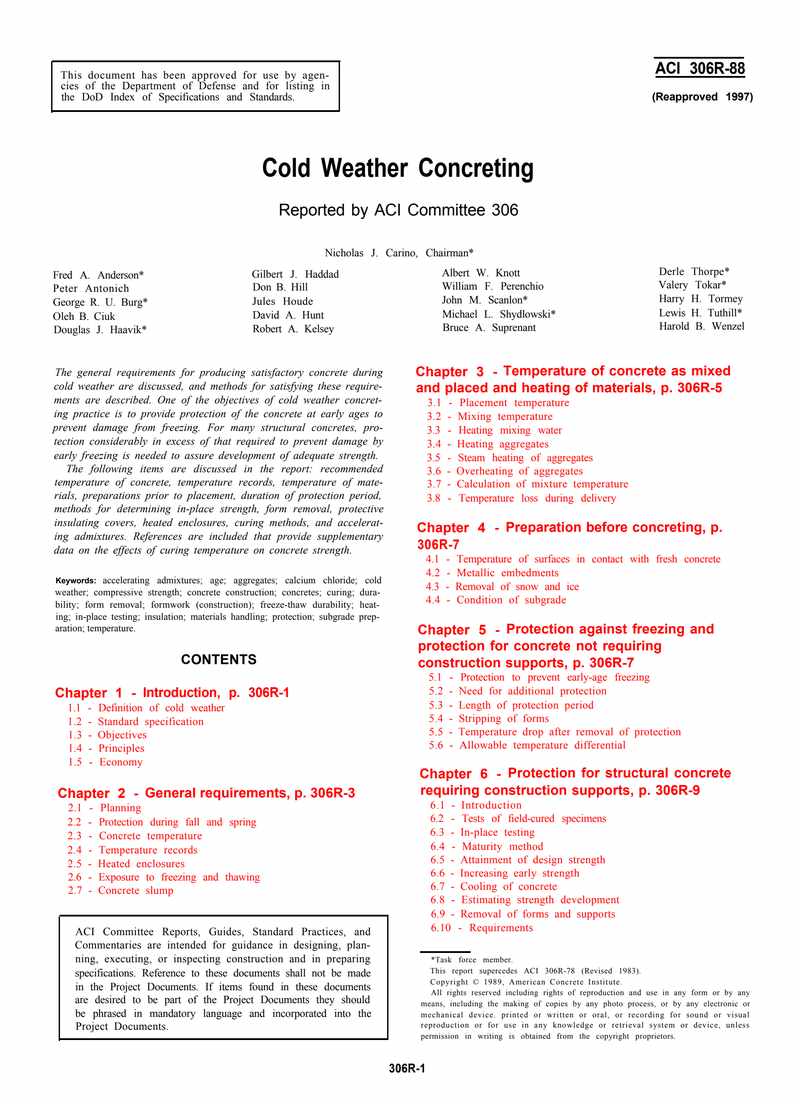

下载标准文件
ACI 306R-88
英语 · PDF · 6 页 · 364.88 KB