part_12_cover_ack_toc
新与修复路面结构力学-经验设计指南
part_12_cover_ack_toc
Guide for Mechanistic-Empirical Design of New and Rehabilitated Pavement Structures

标准信息
STANDARD INFORMATION- 标准编号
- part_12_cover_ack_toc
- 所属分类
- 其他国外标准与工程资料
- 发布机构
- National Cooperative Highway Research Program
- 版本年份
- 2004
- 文件语言
- 英语
- 文件格式
- 文件页数
- 6 页
- 文件大小
- 233.49 KB
中文名称为参考译名,文件语言以原文为准。
· 更新:
标准简介
OVERVIEW中文简介
该报告介绍新与修复路面结构的力学-经验设计指南,涵盖设计输入、损伤预测模型、气候建模和设计可靠性等内容。它适用于公路路面结构设计与修复,并总结了未来研发需求。
English summary
This report presents a mechanistic-empirical design guide for new and rehabilitated pavement structures, covering design inputs, distress prediction models, climatic modeling, and design reliability. It applies to highway pavement design and rehabilitation and outlines future research and development needs.
以上为根据文件整理的内容简介。
相关标签
标准内容预览
DOCUMENT PREVIEWDesign Reliability
The procedure for design reliability included in the Design Guide while considered adequate for initial implementation should be considered as a place holder for a more comprehensive procedure. The identification of an improved methodology for design reliability is considered a top priority by the research team. The current method for incorporating reliability into the Design Guide is based upon the assessment of the overall standard error of the predicted distress as compared to observed distress. An improved procedure should make it possible to consider all of the key components of variability and uncertainty involved in pavement design. This would make it possible for the designer to input the mean, variance, and distribution of many key inputs and also incorporate the errors associated with the prediction models providing for a much more accurate design reliability. The designer would then be able to determine the sensitivity of the outputs (cracking, rutting, faulting, IRI, etc.) to variations in the inputs providing designers with improved knowledge of the most critical inputs that should be estimated with greater accuracy.
It is highly recommended that a continuing effort be made to incorporate such a design reliability approach in a reasonable and practical manner. It is cautioned, however, that a critical factor in this solution will be related to the computational time required for such an analysis which makes a Monte Carlo simulation approach somewhat impractical. There exist a number of modern approaches to reliability that can be explored that should provide a reasonable solution that makes it possible to have the above desired characteristics.
However, with such a more comprehensive reliability approach, the estimation of all associated variances and uncertainties will be required. This will require a large major research effort. This would include estimation of variations and uncertainties associated with traffic loadings, climate, material properties, layer thickness, and many other design inputs. It would also include errors associated with all models included in the design guide. An improved reliability procedure should not be attempted if a large allocation of resources is not available to estimate all of the applicable variations and uncertainties associated with all inputs and models. Such a procedure without good estimates of variances of all key inputs and prediction models would be completely misleading and erroneous.
Calibration-Validation of Prediction Models for Level 1, 2, and 3 Inputs
The major premise, upon which the hierarchical input system was devised, is that the standard error associated with the prediction of a given distress mode decreases as the level of engineering effort, intensity and testing is increased. This can be stated in an alternate manner by understanding that the reliability of the design prediction should logically increase when the level of the engineering effort used to obtain inputs is increased. This would logically lead to a reduction in life cycle costs of pavements.
In the Design Guide, it was only possible to demonstrate that this concept was applicable and valid for the thermal fracture module. It is recommended that this hypothesis be confirmed, to the practicing profession, for at least one major mode of load-associated distress. This is necessary because it is very important to illustrate to the engineering community that additional time, effort and design funding will actually result in a lower cost and longer performing product. If this is not demonstrated quickly, it is possible that engineers may simple be lulled into
6
ACKNOWLEDGMENT OF SPONSORSHIP
This work was sponsored by the American Association of State Highway and Transportation Officials, in cooperation with the Federal Highway Administration, and was conducted in the National Cooperative Highway Research Program, which is administered by the Transportation Research Board of the National Research Council.
DISCLAIMER
This is the final draft as submitted by the research agency. The opinions and conclusions expressed or implied in the report are those of the research agency. They are not necessarily those of the Transportation Research Board, the National Research Council, the Federal Highway Administration, the American Association of State Highway and Transportation Officials, or the individual states participating in the National Cooperative Highway Research Program.
2
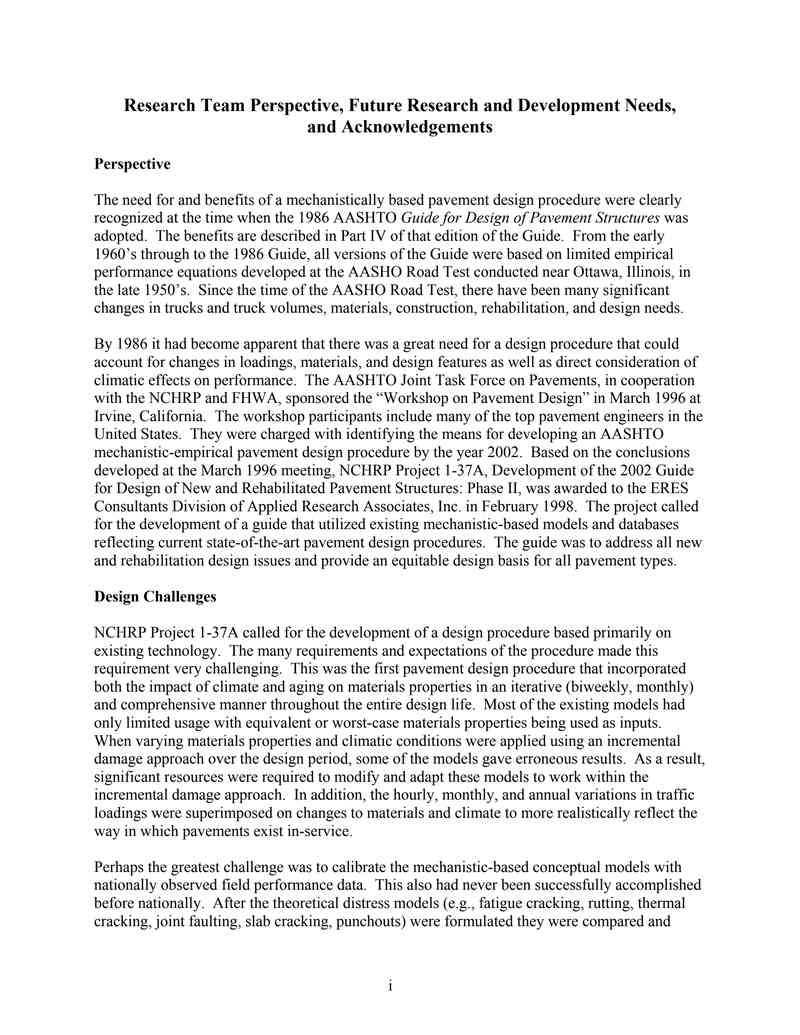
Research Team Perspective, Future Research and Development Needs, and Acknowledgements
Perspective
The need for and benefits of a mechanistically based pavement design procedure were clearly recognized at the time when the 1986 AASHTO Guide for Design of Pavement Structures was adopted. The benefits are described in Part IV of that edition of the Guide. From the early 1960's through to the 1986 Guide, all versions of the Guide were based on limited empirical performance equations developed at the AASHO Road Test conducted near Ottawa, Illinois, in the late 1950's. Since the time of the AASHO Road Test, there have been many significant changes in trucks and truck volumes, materials, construction, rehabilitation, and design needs.
By 1986 it had become apparent that there was a great need for a design procedure that could account for changes in loadings, materials, and design features as well as direct consideration of climatic effects on performance. The AASHTO Joint Task Force on Pavements, in cooperation with the NCHRP and FHWA, sponsored the "Workshop on Pavement Design" in March 1996 at Irvine, California. The workshop participants include many of the top pavement engineers in the United States. They were charged with identifying the means for developing an AASHTO mechanistic-empirical pavement design procedure by the year 2002. Based on the conclusions developed at the March 1996 meeting, NCHRP Project 1-37A, Development of the 2002 Guide for Design of New and Rehabilitated Pavement Structures: Phase II, was awarded to the ERES Consultants Division of Applied Research Associates, Inc. in February 1998. The project called for the development of a guide that utilized existing mechanistic-based models and databases reflecting current state-of-the-art pavement design procedures. The guide was to address all new and rehabilitation design issues and provide an equitable design basis for all pavement types.
Design Challenges
NCHRP Project 1-37A called for the development of a design procedure based primarily on existing technology. The many requirements and expectations of the procedure made this requirement very challenging. This was the first pavement design procedure that incorporated both the impact of climate and aging on materials properties in an iterative (biweekly, monthly) and comprehensive manner throughout the entire design life. Most of the existing models had only limited usage with equivalent or worst-case materials properties being used as inputs. When varying materials properties and climatic conditions were applied using an incremental damage approach over the design period, some of the models gave erroneous results. As a result, significant resources were required to modify and adapt these models to work within the incremental damage approach. In addition, the hourly, monthly, and annual variations in traffic loadings were superimposed on changes to materials and climate to more realistically reflect the way in which pavements exist in-service.
Perhaps the greatest challenge was to calibrate the mechanistic-based conceptual models with nationally observed field performance data. This also had never been successfully accomplished before nationally. After the theoretical distress models (e.g., fatigue cracking, rutting, thermal cracking, joint faulting, slab cracking, punchouts) were formulated they were compared and
3
calibrated against observed data. The results were then evaluated which lead to improvements to the model, which in turn required another time-consuming calibration. This process was repeated many times to achieve each of the final acceptable mechanistic-based distress prediction models. In the end, this laborious approach proved to be extremely valuable in producing models that could reasonably predict observed pavement performance. After model calibration was completed, design reliability was incorporated into the design procedure by considering the residual between observed and predicted distress. This approach was necessitated because computer run times for the simulation approach were not practical at this time but will be in the future.
The final challenge was to incorporate the complex models and design concepts into a stable and user-friendly software package. The NCHRP 1-37A team realized that no matter how technically correct the design method is, adoption of the software will be hindered if the software is not accessible and easy to use. Therefore, extensive effort was expended in making the software user-friendly and minimizes potential input errors. This was accomplished as follows:
- Inputs: Assurance that proper inputs are utilized through use of carefully selected default values, recommended and absolute ranges for each input.
- Help: Context-sensitive and on-line help.
- Outputs: Tabular and graphical Excel/HTML based outputs to help the designer visualize the performance of their trial design.
- Climatic database: Hourly climatic data from over 800 locations in North America are included, which allows the user to easily select a given station or to generate virtual weather stations.
Another very important aspect of the design procedure and software is that improvements can be made over time in a piecewise manner to any of the component models (distresses, IRI, climatic, traffic, materials, and structural responses) and incorporated into the procedure for re-calibration. The framework has been laid for future updates. Ranges and default values of design inputs can be set by local agencies. The key limitation is the longer run time for flexible pavement design and rehabilitation. This can be improved through software optimization.
Future Needs for Continued Improvement of the Design Guide
Perhaps the most important characteristic of the Design Guide is its technological and modular framework for pavement design and its calibration-validation process. The bi-monthly/monthly incremental damage approach makes it possible to improve virtually any model and algorithmic subsystem over time. Any model or algorithm, from the various structural responses models to modulus prediction models to fatigue damage models, can be replaced with improved versions as they become available with further research. However, changes to models or algorithms that affect distress and smoothness predictions may require re-calibration with field data. The Design Guide provides the needed "focal" point for development and improvement of pavement design over time.
The NCHRP 1-37A project was required to use proven state-of-the-art technology. While this gave the research team a lot of possibilities, it restricted the team and prevented the use of some
4
technology that might, after additional development, have resulted in better prediction models. However, it soon became apparent that even supposedly proven technology had major problems and required significant improvements and modifications before it would work within the mechanistic design framework. Many needed improvements were accomplished, but within the complex engineering system developed there exists several areas that need further development. The research team and the many individuals who assisted in reviewing the design procedure over the past several years identified a number of aspects that could be improved. This section provides a brief summary of those improvements.
Climatic Modeling
One of the major advances of the Design Guide was to integrate the weather station driven EICM model (Enhanced Integrated Climatic Model) directly with procedures to predict pavement and subgrade layer material modulus changes and gradients due to changes in temperature and moisture content within the pavement structure. The layer moduli values and temperature and moisture gradients and their integration within a comprehensive structural analysis methodology were implemented into the Design Guide to provide capabilities never before available. However, there are still several issues that need to be addressed in order to improve the accuracy of the overall climatic-materials interactive subsystem. Major changes in the subsurface moisture distribution had to be made in the EICM version to improve the predictions of the subsurface moisture content. These changes, predominantly in the SWCC relationships used to define the state of soil suction, were implemented and are now a part of the latest EICM version used in the Design Guide.
NCHRP 9-23 is nearing completion to enhance the subsurface moisture prediction methodology in the EICM and it is recommended that the NCHRP 9-23 results, conclusions, and suggested modifications to the EICM moisture model be directly incorporated into the Design Guide. There are several other minor areas that need further improvement in the EICM model. Problems still exist with the prediction of moisture in quality granular bases. The problem that occurs is that, due to the soil suction properties of these materials, little, if any, moisture can be drawn into the layer due to suction. For flexible pavement, no surface infiltration was allowed. As a consequence, moisture contents become exceedingly low, and base moduli are predicted to be abnormally high. A better infiltration model for both rigid and flexible pavements that predicts infiltration over time is needed. Finally, the current version of the EICM model in the Design Guide still uses an "empirical" recovery period, based upon soil type, to define the moisture – time changes after thaw weakening has occurred. It is recommended that a more mechanistic solution for this recovery process be developed.
Another aspect which will require continual, periodic updates to the Design Guide software involves updating the weather station databases with the latest information from the NCDC. The design guide at the present time contains historical hourly weather information for approximately 800 weather stations in North America. At the time the performance models were calibrated, for most of these stations, the historical records contain information that spans over a five-year period. However, it is recognized that an enhanced database will perhaps lead to a better calibrated models and will also help establish the key climatic variable more accurately.
Design Reliability
The procedure for design reliability included in the Design Guide while considered adequate for initial implementation should be considered as a place holder for a more comprehensive procedure. The identification of an improved methodology for design reliability is considered a top priority by the research team. The current method for incorporating reliability into the Design Guide is based upon the assessment of the overall standard error of the predicted distress as compared to observed distress. An improved procedure should make it possible to consider all of the key components of variability and uncertainty involved in pavement design. This would make it possible for the designer to input the mean, variance, and distribution of many key inputs and also incorporate the errors associated with the prediction models providing for a much more accurate design reliability. The designer would then be able to determine the sensitivity of the outputs (cracking, rutting, faulting, IRI, etc.) to variations in the inputs providing designers with improved knowledge of the most critical inputs that should be estimated with greater accuracy.
It is highly recommended that a continuing effort be made to incorporate such a design reliability approach in a reasonable and practical manner. It is cautioned, however, that a critical factor in this solution will be related to the computational time required for such an analysis which makes a Monte Carlo simulation approach somewhat impractical. There exist a number of modern approaches to reliability that can be explored that should provide a reasonable solution that makes it possible to have the above desired characteristics.
However, with such a more comprehensive reliability approach, the estimation of all associated variances and uncertainties will be required. This will require a large major research effort. This would include estimation of variations and uncertainties associated with traffic loadings, climate, material properties, layer thickness, and many other design inputs. It would also include errors associated with all models included in the design guide. An improved reliability procedure should not be attempted if a large allocation of resources is not available to estimate all of the applicable variations and uncertainties associated with all inputs and models. Such a procedure without good estimates of variances of all key inputs and prediction models would be completely misleading and erroneous.
Calibration-Validation of Prediction Models for Level 1, 2, and 3 Inputs
The major premise, upon which the hierarchical input system was devised, is that the standard error associated with the prediction of a given distress mode decreases as the level of engineering effort, intensity and testing is increased. This can be stated in an alternate manner by understanding that the reliability of the design prediction should logically increase when the level of the engineering effort used to obtain inputs is increased. This would logically lead to a reduction in life cycle costs of pavements.
In the Design Guide, it was only possible to demonstrate that this concept was applicable and valid for the thermal fracture module. It is recommended that this hypothesis be confirmed, to the practicing profession, for at least one major mode of load-associated distress. This is necessary because it is very important to illustrate to the engineering community that additional time, effort and design funding will actually result in a lower cost and longer performing product. If this is not demonstrated quickly, it is possible that engineers may simple be lulled into
6
预览内容由文件识别整理,表格、公式及文字请以原始文件为准。
原文图片预览
PAGE IMAGES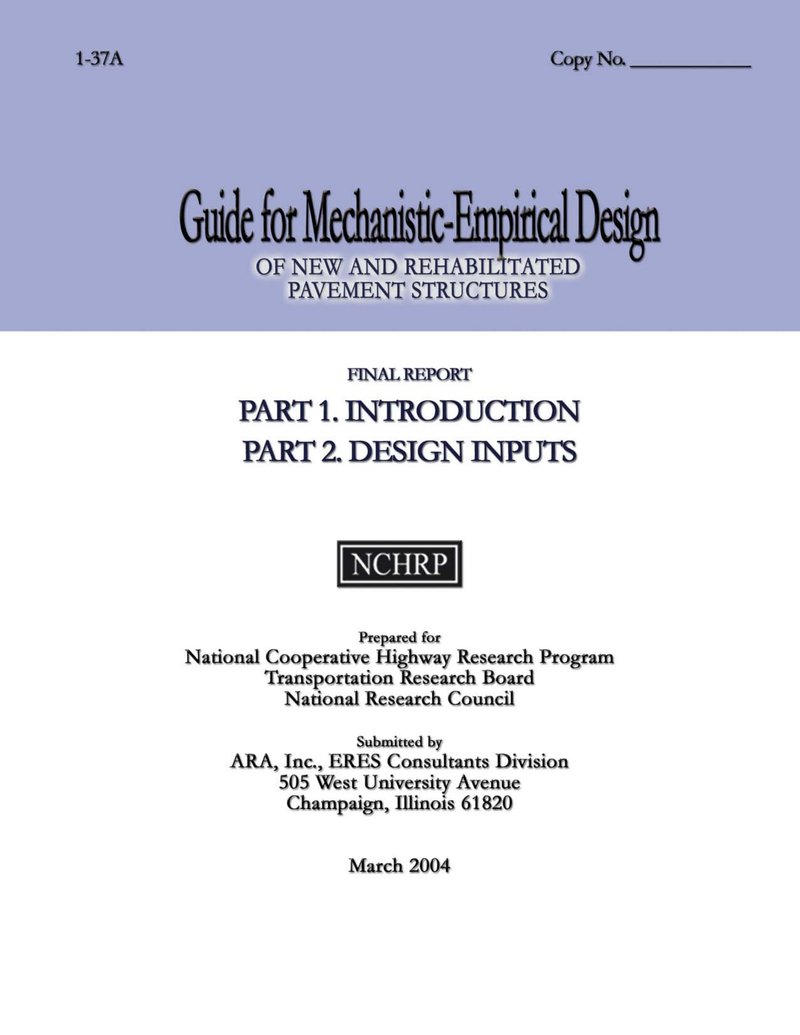


下载标准文件
part_12_cover_ack_toc
英语 · PDF · 6 页 · 233.49 KB