简支钢梁设计-Design of Simply-Supported Composite Beams
简支组合梁强度设计(依据澳大利亚标准 AS 2327.1–1996)
简支钢梁设计-Design of Simply-Supported Composite Beams for Strength
Design of Simply-Supported Composite Beams for Strength
标准信息
STANDARD INFORMATION- 标准编号
- 简支钢梁设计-Design of Simply-Supported Composite Beams
- 所属分类
- 其他国外标准与工程资料
- 发布机构
- OneSteel Market Mills
- 版本年份
- 2001
- 文件语言
- 英语
- 文件格式
- 文件页数
- 6 页
- 文件大小
- 1008.92 KB
中文名称为参考译名,文件语言以原文为准。
· 更新:
标准简介
OVERVIEW中文简介
该设计手册是OneSteel组合结构设计手册的一部分,旨在解释澳大利亚标准AS 2327.1-1996中关于简支组合梁强度设计的方法。它提供了详细的工程原理说明、设计规则及计算示例,帮助结构工程师理解并应用该标准进行组合钢结构建筑的设计。
English summary
This design booklet is part of the OneSteel Composite Structures Design Manual and explains the strength design method for simply-supported composite beams according to Australian Standard AS 2327.1-1996. It provides detailed engineering principles, design rules, and worked examples to assist structural engineers in designing composite steel-frame buildings.
以上为根据文件整理的内容简介。
相关标签
标准内容预览
DOCUMENT PREVIEWDesign of Simply-Supported Composite Beams for Strength
(To Australian Standard AS 2327.1–1996)
Design Booklet DB1.1
OneSteel Market Mills
Composite Structures Design Manual
February 2001
1
OneSteel Market Mills Composite Structures Design Manual
Published by
OneSteel Manufacturing Limited
ABN 42 004 651 325
Produced by the
Centre for Construction Technology & Research
University of Western Sydney
Contributors
Dr. Mark Patrick *
Centre for Construction Technology & Research
Dr. Daya Dayawansa *
Mr. Rodney Wilkie *
* Formerly BHP Melbourne Research Laboratories
Reviewed by
Prof. Russell Bridge
Centre for Construction Technology & Research
Mr. Mark Sheldon
Connell Wagner
Mr. Ken Watson
Formerly BHP Integrated Steel
Edition 1.0 - May 1998
Edition 2.0 - February 2001
Disclaimer
While every effort has been made and all reasonable care taken to ensure the accuracy of the material contained herein, the contributors, editors and publishers of this booklet shall not be held liable or responsible in any way whatsoever, and expressly disclaim any liability or responsibility for any loss or damage, cost or expenses, howsoever incurred by any person whether the user of the booklet or otherwise including without limitation, loss or damage, costs or expenses incurred as a result of or in connection with the reliance, whether whole or partial by any person as a foresaid upon any part of the contents of this booklet. Should expert assistance be required, the services of a competent person should be sought.
2
Foreword
OneSteel is a leading manufacturer of steel long products in Australia after its spin-off from BHP Pty Ltd on the 1st November 2000. It manufactures a wide range of steel products, including structural, rail, rod, bar, wire, pipe and tube products and markets welded beams.
OneSteel is committed to providing to design engineers, technical information and design tools to assist with the use, design and specification of its products. This design booklet “Design of Simply-Supported Composite Beams for Strength” was one of the first two design booklets of the Composite Structures Design Manual, which is now being completed and maintained by OneSteel.
The initial development work required to produce the design booklets was carried out at BHP Melbourne Research Laboratories before its closure in May 1998. OneSteel Market Mills is funding the University of Western Sydney’s Centre for Construction Technology and Research in continuing the research and development work to publish this and future booklets.
The Composite Structures Design Manual refers specifically to the range of long products that are manufactured by OneSteel and plate products that continue to be manufactured by BHP. It is strongly recommended that OneSteel sections and reinforcement and BHP plate products are specified for construction when any of the design models in the design booklets are used, as the models and design formulae including product tolerances, mechanical properties and chemical composition have been validated by detailed structural testing using only OneSteel and BHP products.
To ensure that the Designer’s intent is met, it is recommended that a note to this effect be included in the design documentation.
3
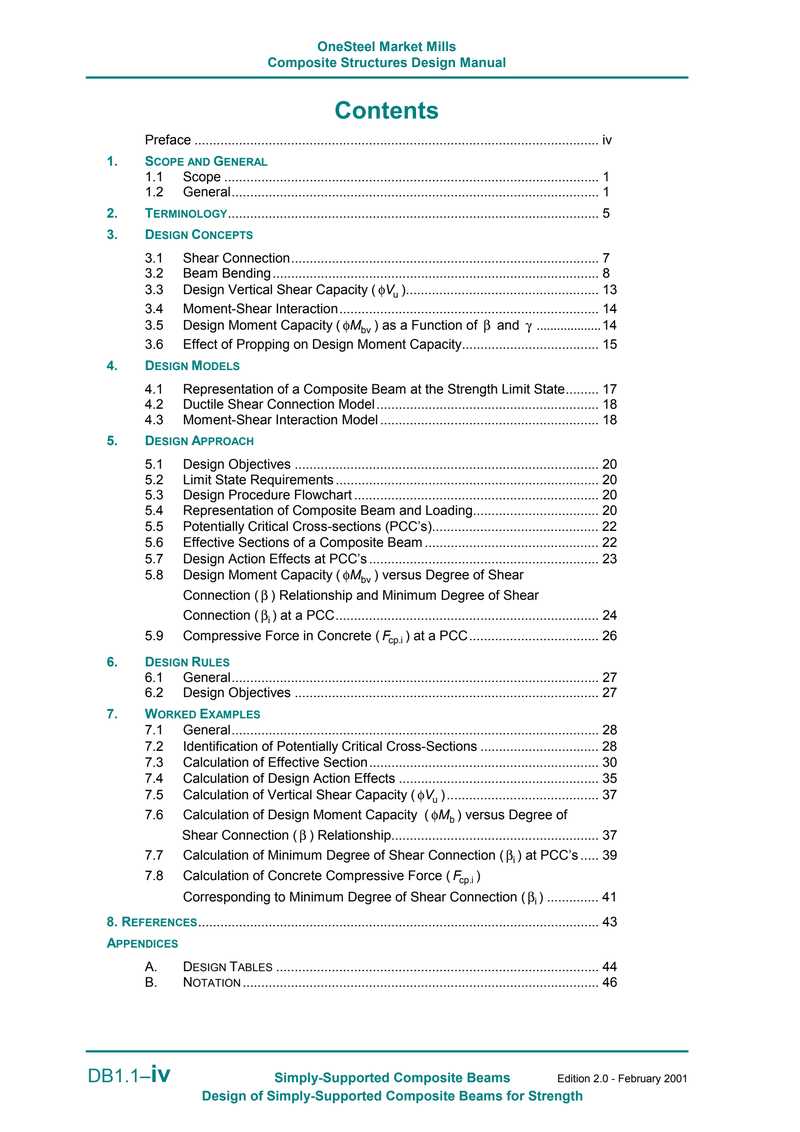
Contents
Preface iv
1. Scope and General
1.1 Scope 1
1.2 General 1
2. Terminology
5
3. Design Concepts
3.1 Shear Connection 7
3.2 Beam Bending 8
3.3 Design Vertical Shear Capacity (φVU) 13
3.4 Moment-Shear Interaction 14
3.5 Design Moment Capacity (φMbv) as a Function of β and γ 14
3.6 Effect of Propping on Design Moment Capacity 15
4. Design Models
4.1 Representation of a Composite Beam at the Strength Limit State 17
4.2 Ductile Shear Connection Model 18
4.3 Moment-Shear Interaction Model 18
5. Design Approach
5.1 Design Objectives 20
5.2 Limit State Requirements 20
5.3 Design Procedure Flowchart 20
5.4 Representation of Composite Beam and Loading 20
5.5 Potentially Critical Cross-sections (PCC's) 22
5.6 Effective Sections of a Composite Beam 22
5.7 Design Action Effects at PCC's 23
5.8 Design Moment Capacity (φMbv) versus Degree of Shear Connection (β) Relationship and Minimum Degree of Shear Connection (βi) at a PCC 24
5.9 Compressive Force in Concrete (Fcp,i) at a PCC 26
6. Design Rules
6.1 General 27
6.2 Design Objectives 27
7. Worked Examples
7.1 General 28
7.2 Identification of Potentially Critical Cross-Sections 28
7.3 Calculation of Effective Section 30
7.4 Calculation of Design Action Effects 35
7.5 Calculation of Vertical Shear Capacity (φVU) 37
7.6 Calculation of Design Moment Capacity (φMb) versus Degree of Shear Connection (β) Relationship 37
7.7 Calculation of Minimum Degree of Shear Connection (βi) at PCC's 39
7.8 Calculation of Concrete Compressive Force (Fcp,i) Corresponding to Minimum Degree of Shear Connection (βi) 41
8. References
43
Appendices
A. Design Tables 44
B. Notation 46
4
Preface
This design booklet forms part of a suite of booklets covering the design of simply-supported and continuous composite beams, composite slabs, composite columns, steel and composite connections and related topics. The booklets are part of the OneSteel Market Mills' Composite Structures Design Manual which has been produced to foster composite steel-frame building construction in Australia to ensure cost-competitive building solutions for specifiers, builders and developers.
Simply-supported composite beams have been favoured in the construction of composite steel-frame buildings in Australia. This is essentially because simple steel connections such as the web-side-plate connection (see design booklet DB5.1 – Design of the Web-Side-Plate Steel Connection) are very economical to use when the steel frame is erected.
This design booklet contains important explanatory information and worked examples about the strength design method in Section 6 of Australian Standard AS 2327.1-1996, Composite Structures, Part 1: Simply Supported Beams. It is intended that this information will assist structural design engineers to understand the engineering principles on which the design method is based. The coverage of the strength design method is continued in design booklet DB1.2 – Design of the Shear Connection of Simply-Supported Composite Beams (To Australian Standard AS 2327.1-1996).
Design aids have already been prepared to support the use of the design method, and are included in the Composite Beam Design Handbook (in Accordance with AS 2327.1-1996) [2] published jointly by the AISC and Standards Australia. These comprise Design Tables (Appendix A) and computer software (COMPBEEAM™). Although these design aids are intended to make the design process more efficient, it is essential that the users have a clear understanding of the design concepts and design rules prior to using them.
The strength design method in AS 2327.1 is based on partial shear connection strength theory and rectangular stress block theory, and is applicable to the design of composite beams with compact steel sections and ductile shear connection. Non-compact steel sections can be catered for by representing them in design as equivalent compact sections. Slender steel sections are not permitted. Details for ensuring that ductile shear connection is achieved are given in Sections 8 and 9 of AS 2327.1, and explanatory information about these rules can be found in design booklet DB1.2. Computer program COMPSHEAR™ can be used in association with COMPBEAM™ to design the shear connection in accordance with DB1.2.
The method of strength design presented for simply-supported composite beams has also been extended to cover the design of continuous composite beams, noting that very similar principles apply. The reader is referred to design booklet DB2.1 – Design of Continuous and Semi-Continuous Composite Beams with Rigid Connections for Strength, and an associated computer program COMPSECT™. Partial shear connection strength theory is also applicable to the design of composite slabs with ductile shear connection, which is also covered in a separate design booklet DB3.1 – Design of Composite Slabs for Strength. Finally, it is important to point out that the strength design method in AS 2327.1 is in harmony with leading overseas Codes, Standards and Design Specifications which address the design of composite beams.
Edition 1.0 was published by BHP in May 1998. Edition 2.0 contains some minor corrections to the first edition, and is published by OneSteel.
5
Page
6
预览内容由文件识别整理,表格、公式及文字请以原始文件为准。
原文图片预览
PAGE IMAGES
下载标准文件
简支钢梁设计-Design of Simply-Supported Composite Beams
英语 · PDF · 6 页 · 1008.92 KB