ASNZS1170.2 2002 Structural Design Actions - Wind
结构设计作用 第2部分:风作用
ASNZS1170.2 2002 Structural Design Actions - Wind Actions (incl Amdt 1)
Structural design actions Part 2: Wind actions
标准信息
STANDARD INFORMATION- 标准编号
- ASNZS1170.2 2002 Structural Design Actions - Wind
- 所属分类
- AS 澳大利亚标准
- 发布机构
- Standards Australia/Standards New Zealand
- 版本年份
- 2002
- 文件语言
- 英语
- 文件格式
- 文件页数
- 6 页
- 文件大小
- 2.01 MB
中文名称为参考译名,文件语言以原文为准。
· 更新:
标准简介
OVERVIEW中文简介
该标准规定了结构设计中风作用的详细确定方法,包括场地风速、设计风速、风压和风荷载。它适用于澳大利亚和新西兰的结构设计,并纳入第1号修正案。
English summary
This standard provides detailed procedures for determining wind actions on structures, including site wind speeds, design wind speeds, wind pressures and wind loads. It is intended for structural design in Australia and New Zealand and incorporates Amendment No. 1.
以上为根据文件整理的内容简介。
相关标签
标准内容预览
DOCUMENT PREVIEWA1
In AS/NZS 1170.2, Table 3.1 gives the regional wind speeds for selected annual probabilities of exceedance and Section 2 sets out the determination of site wind speeds, design wind speeds, design wind pressures and wind actions (forces or loads) that are appropriate for the annual probability specified.
The annual probability of exceedance is not defined in AS/NZS 1170.2, but is set out in AS/NZS 1170.0 [and by further reference for ultimate limit states in the BCA (Table of annual probabilities of exceedance) and in the Guide to the BCA (examples of structures for importance levels)]. AS/NZS 1170.0 gives the annual probability of exceedance for New Zealand structures and for Australian structures not covered by the BCA. Guidance for serviceability events and associated limits is given in an informative Appendix of AS/NZS 1170.0 for loads associated with an appropriate annual probability of exceedance (P) for serviceability.
6
AS/NZS 1170.2:2002
This Joint Australian/New Zealand Standard was prepared by Joint Technical Committee BD-006, General Design Requirements and Loading on Structures. It was approved on behalf of the Council of Standards Australia on 29 March 2002 and on behalf of the Council of Standards New Zealand on 28 March 2002. This Standard was published on 4 June 2002.
The following are represented on Committee BD-006:
Association of Consulting Engineers Australia
Australian Building Codes Board
Australian Institute of Steel Construction
Building Research Association of New Zealand
Cement and Concrete Association of Australia
CSIRO Building, Construction and Engineering
Cyclone Testing Station—James Cook University
Electricity Supply Association of Australia
Housing Industry Association
Institution of Engineers Australia
Institution of Professional Engineers New Zealand
Master Builders Australia
New Zealand Heavy Engineering Research Association
Steel Reinforcement Institute of Australia
University of Canterbury New Zealand
University of Melbourne
University of Newcastle
Additional Interests:
Bureau of Meteorology
Curtin University of Technology
Monash University
National Institute of Water and Atmospheric Research, NZ
University of Queensland
Keeping Standards up-to-date
Standards are living documents which reflect progress in science, technology and systems. To maintain their currency, all Standards are periodically reviewed, and new editions are published. Between editions, amendments may be issued. Standards may also be withdrawn. It is important that readers assure themselves they are using a current Standard, which should include any amendments which may have been published since the Standard was purchased.
Detailed information about joint Australian/New Zealand Standards can be found by visiting the Standards Web Shop at www.standards.com.au or Standards New Zealand web site at www.standards.co.nz and looking up the relevant Standard in the on-line catalogue.
Alternatively, both organizations publish an annual printed Catalogue with full details of all current Standards. For more frequent listings or notification of revisions, amendments and withdrawals, Standards Australia and Standards New Zealand offer a number of update options. For information about these services, users should contact their respective national Standards organization.
We also welcome suggestions for improvement in our Standards, and especially encourage readers to notify us immediately of any apparent inaccuracies or ambiguities. Please address your comments to the Chief Executive of either Standards Australia or Standards New Zealand at the address shown on the back cover.
This Standard was issued in draft form for comment as DR 99419.
2
AS/NZS 1170.2:2002
(Incorporating Amendment No. 1)
Australian/New Zealand Standard™
Structural design actions
Part 2: Wind actions
Originated in Australia as part of AS CA1—1933.
Originated in New Zealand as part of NZS 1900:1964.
Previous Australian edition AS 1170.2—1989.
Previous New Zealand edition NZS 4203:1992.
AS 1170.2—1989 and NZS 4203:1992 jointly revised, amalgamated and redesignated in part as AS/NZS 1170.2:2002.
Reissued incorporating Amendment No. 1 (April 2005).
COPYRIGHT
© Standards Australia/Standards New Zealand
All rights are reserved. No part of this work may be reproduced or copied in any form or by any means, electronic or mechanical, including photocopying, without the written permission of the publisher.
Jointly published by Standards Australia, GPO Box 5420, Sydney, NSW 2001 and Standards New Zealand, Private Bag 2439, Wellington 6020
ISBN 0 7337 4473 7
3
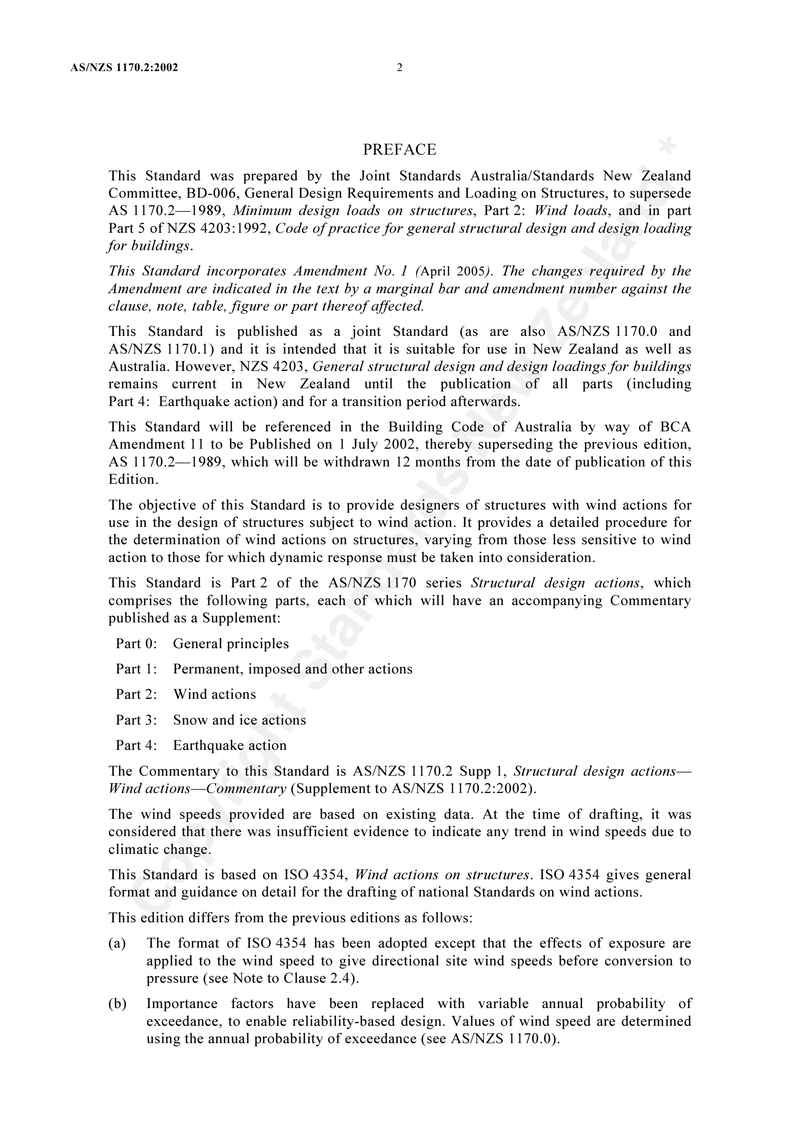
PREFACE
This Standard was prepared by the Joint Standards Australia/Standards New Zealand Committee, BD-006, General Design Requirements and Loading on Structures, to supersede AS 1170.2—1989, Minimum design loads on structures, Part 2: Wind loads, and in part Part 5 of NZS 4203:1992, Code of practice for general structural design and design loading for buildings.
This Standard incorporates Amendment No. 1 (April 2005). The changes required by the Amendment are indicated in the text by a marginal bar and amendment number against the clause, note, table, figure or part thereof affected.
This Standard is published as a joint Standard (as are also AS/NZS 1170.0 and AS/NZS 1170.1) and it is intended that it is suitable for use in New Zealand as well as Australia. However, NZS 4203, General structural design and design loadings for buildings remains current in New Zealand until the publication of all parts (including Part 4: Earthquake action) and for a transition period afterwards.
This Standard will be referenced in the Building Code of Australia by way of BCA Amendment 11 to be Published on 1 July 2002, thereby superseding the previous edition, AS 1170.2—1989, which will be withdrawn 12 months from the date of publication of this Edition.
The objective of this Standard is to provide designers of structures with wind actions for use in the design of structures subject to wind action. It provides a detailed procedure for the determination of wind actions on structures, varying from those less sensitive to wind action to those for which dynamic response must be taken into consideration.
This Standard is Part 2 of the AS/NZS 1170 series Structural design actions, which comprises the following parts, each of which will have an accompanying Commentary published as a Supplement:
Part 0: General principles
Part 1: Permanent, imposed and other actions
Part 2: Wind actions
Part 3: Snow and ice actions
Part 4: Earthquake action
The Commentary to this Standard is AS/NZS 1170.2 Supp 1, Structural design actions—Wind actions—Commentary (Supplement to AS/NZS 1170.2:2002).
The wind speeds provided are based on existing data. At the time of drafting, it was considered that there was insufficient evidence to indicate any trend in wind speeds due to climatic change.
This Standard is based on ISO 4354, Wind actions on structures. ISO 4354 gives general format and guidance on detail for the drafting of national Standards on wind actions.
This edition differs from the previous editions as follows:
(a) The format of ISO 4354 has been adopted except that the effects of exposure are applied to the wind speed to give directional site wind speeds before conversion to pressure (see Note to Clause 2.4).
(b) Importance factors have been replaced with variable annual probability of exceedance, to enable reliability-based design. Values of wind speed are determined using the annual probability of exceedance (see AS/NZS 1170.0).
4
- (c) It is a joint Standard intended for use in Australia and New Zealand.
- (d) Average roof height is used to calculate wind pressures for rectangular enclosed buildings.
- (e) Actions determined from wind tunnel tests or other methods are not covered through the ‘deemed-to-comply’ solution given in this Standard, but must be separately established (by a special study; see AS/NZS 1170.0).
- (f) A simplified procedure is not included.
- (g) Wind speeds for permissible stress design are not included (see the Commentary, AS/NZS 1170.2 Supp 1).
- (h) Directional wind speed multipliers have been revised and extended beyond the capital cities in Australia.
- (i) Generally, the clauses have been updated to incorporate the latest research and to improve useability. The following new information has been included:
- (i) Elevation effect for Tasmania.
- (ii) Separation zone for crests of steeper slopes.
- (iii) Combination factor for major structural members.
- (iv) Parapet reduction factor.
- (v) Hyperbolic paraboloid roofs.
- (vi) Methods for open lattice structures and lattice towers (including ancillaries).
- (vii) Flags and spheres.
- (j) The calculation of dynamic wind response has been simplified and the use of an hourly mean wind speed for dynamic analysis has been replaced with the 3 s gust. When dynamic response is to be determined, a single additional factor is determined.
The Joint Committee has considered exhaustive research and testing information from Australian, New Zealand and overseas sources in the preparation of this Standard. The design wind actions prescribed in this Standard are the minimum for the general cases described.
Particular acknowledgment should be given to Monash University, University of Queensland, James Cook University, Curtin University of Technology, Building Research Association of New Zealand, Bureau of Meteorology (Aust) and National Institute of Water and Atmospheric Research (NZ) for their contributions to the drafting of this Standard.
The terms ‘normative’ and ‘informative’ have been used in this Standard to define the application of the appendix to which they apply. A ‘normative’ appendix is an integral part of a Standard, whereas an ‘informative’ appendix is only for information and guidance.
Statements expressed in mandatory terms in notes to tables and figures are deemed to be an integral part of this Standard.
Notes to the text contain information and guidance and are not considered to be an integral part of the Standard.
A1 Essentially, AS/NZS 1170.2 is independent of the design requirement specified—thus becoming a purely technical document. It may be used to calculate wind speeds, wind pressures and wind forces given any annual probability of exceedance. The annual probability of exceedance (P) defines the wind event (in which pressures and forces occur). Thus a major wind storm with an annual probability of exceedance in the range of 1/200 to 1/2500 is used for ultimate limit states, while a much more frequent wind event (say of 1/25) might be used for serviceability limit states.
5
A1
In AS/NZS 1170.2, Table 3.1 gives the regional wind speeds for selected annual probabilities of exceedance and Section 2 sets out the determination of site wind speeds, design wind speeds, design wind pressures and wind actions (forces or loads) that are appropriate for the annual probability specified.
The annual probability of exceedance is not defined in AS/NZS 1170.2, but is set out in AS/NZS 1170.0 [and by further reference for ultimate limit states in the BCA (Table of annual probabilities of exceedance) and in the Guide to the BCA (examples of structures for importance levels)]. AS/NZS 1170.0 gives the annual probability of exceedance for New Zealand structures and for Australian structures not covered by the BCA. Guidance for serviceability events and associated limits is given in an informative Appendix of AS/NZS 1170.0 for loads associated with an appropriate annual probability of exceedance (P) for serviceability.
6
预览内容由文件识别整理,表格、公式及文字请以原始文件为准。
原文图片预览
PAGE IMAGES
下载标准文件
ASNZS1170.2 2002 Structural Design Actions - Wind
英语 · PDF · 6 页 · 2.01 MB