AS NZS 2772.1(Int)-1998 Radiofrequency fields - Ma
射频场 第1部分:最大暴露水平—3 kHz至300 GHz
AS NZS 2772.1(Int)-1998 Radiofrequency fields - Maximum exposure levels - 3 kHz to 300 GHz
Radiofrequency fields Part 1: Maximum exposure levels—3 kHz to 300 GHz
标准信息
STANDARD INFORMATION- 标准编号
- AS NZS 2772.1(Int)-1998 Radiofrequency fields - Ma
- 所属分类
- AS 澳大利亚标准
- 发布机构
- Standards Australia and Standards New Zealand
- 版本年份
- 1998
- 文件语言
- 英语
- 文件格式
- 文件页数
- 6 页
- 文件大小
- 323.58 KB
中文名称为参考译名,文件语言以原文为准。
· 更新:
标准简介
OVERVIEW中文简介
该临时澳新标准规定了3 kHz至300 GHz射频场对人体的最大暴露水平,包括职业和非职业暴露限值、符合性验证及防护措施。标准适用于电磁场人体暴露防护,基于IRPA比吸收率指南,并作为临时标准供进一步审查和公众评议。
English summary
This interim Australian/New Zealand Standard specifies maximum exposure levels for radiofrequency fields from 3 kHz to 300 GHz, including occupational and non-occupational limits, compliance verification, and protective measures. It applies to human exposure to electromagnetic fields and is based on IRPA specific absorption rate guidelines.
以上为根据文件整理的内容简介。
相关标签
标准内容预览
DOCUMENT PREVIEWCONTENTS
| Page | ||
|---|---|---|
| FOREWORD | 4 | |
| 1 | SCOPE | 6 |
| 2 | APPLICATION | 6 |
| 3 | REFERENCED DOCUMENTS | 7 |
| 4 | DEFINITIONS AND UNITS | 7 |
| 5 | EXPOSURE LIMITS—OCCUPATIONAL | 9 |
| 6 | EXPOSURE LIMITS—NON-OCCUPATIONAL | 13 |
| 7 | VERIFICATION OF COMPLIANCE WITH THE STANDARD | 15 |
| 8 | PROTECTION—OCCUPATIONAL EXPOSURE | 19 |
| 9 | PROTECTION—NON-OCCUPATIONAL EXPOSURE | 21 |
| APPENDICES | ||
| A | RATIONALE FOR THE DEVELOPMENT OF THE MAXIMUM EXPOSURE LEVELS FOR RF RADIATION | 22 |
| B | MEDICAL MONITORING | 27 |
6
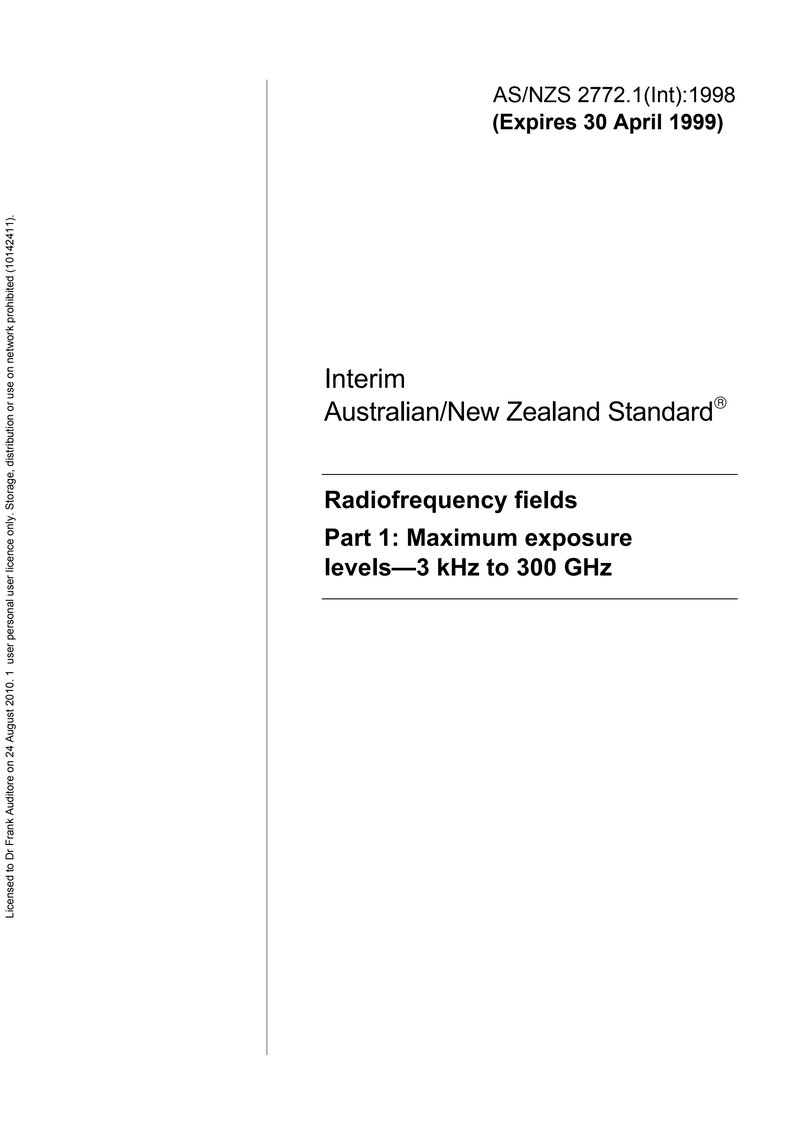
AS/NZS 2772.1(Int):1998
(Expires 30 April 1999)
Interim
Australian/New Zealand Standard®
Radiofrequency fields
Part 1: Maximum exposure levels—3 kHz to 300 GHz
2
AS/NZS 2772.1(Int):1998
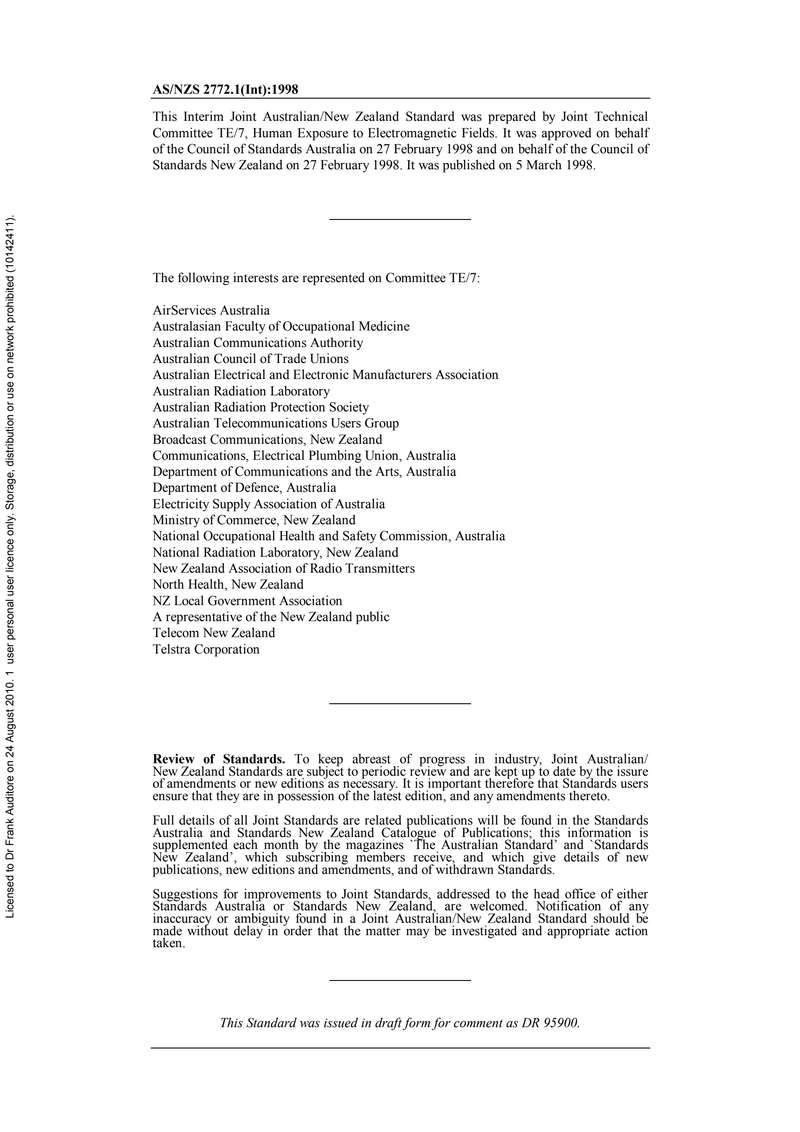
This Interim Joint Australian/New Zealand Standard was prepared by Joint Technical Committee TE/7, Human Exposure to Electromagnetic Fields. It was approved on behalf of the Council of Standards Australia on 27 February 1998 and on behalf of the Council of Standards New Zealand on 27 February 1998. It was published on 5 March 1998.
The following interests are represented on Committee TE/7:
- AirServices Australia
- Australasian Faculty of Occupational Medicine
- Australian Communications Authority
- Australian Council of Trade Unions
- Australian Electrical and Electronic Manufacturers Association
- Australian Radiation Laboratory
- Australian Radiation Protection Society
- Australian Telecommunications Users Group
- Broadcast Communications, New Zealand
- Communications, Electrical Plumbing Union, Australia
- Department of Communications and the Arts, Australia
- Department of Defence, Australia
- Electricity Supply Association of Australia
- Ministry of Commerce, New Zealand
- National Occupational Health and Safety Commission, Australia
- National Radiation Laboratory, New Zealand
- New Zealand Association of Radio Transmitters
- North Health, New Zealand
- NZ Local Government Association
- A representative of the New Zealand public
- Telecom New Zealand
- Telstra Corporation
Review of Standards. To keep abreast of progress in industry, Joint Australian/New Zealand Standards are subject to periodic review and are kept up to date by the issue of amendments or new editions as necessary. It is important therefore that Standards users ensure that they are in possession of the latest edition, and any amendments thereto.
Full details of all Joint Standards and related publications will be found in the Standards Australia and Standards New Zealand Catalogue of Publications; this information is supplemented each month by the magazines 'The Australian Standard' and 'Standards New Zealand', which subscribing members receive, and which give details of new publications, new editions and amendments, and of withdrawn Standards.
Suggestions for improvements to Joint Standards, addressed to the head office of either Standards Australia or Standards New Zealand, are welcomed. Notification of any inaccuracy or ambiguity found in a Joint Australian/New Zealand Standard should be made without delay in order that the matter may be investigated and appropriate action taken.
This Standard was issued in draft form for comment as DR 95900.
3
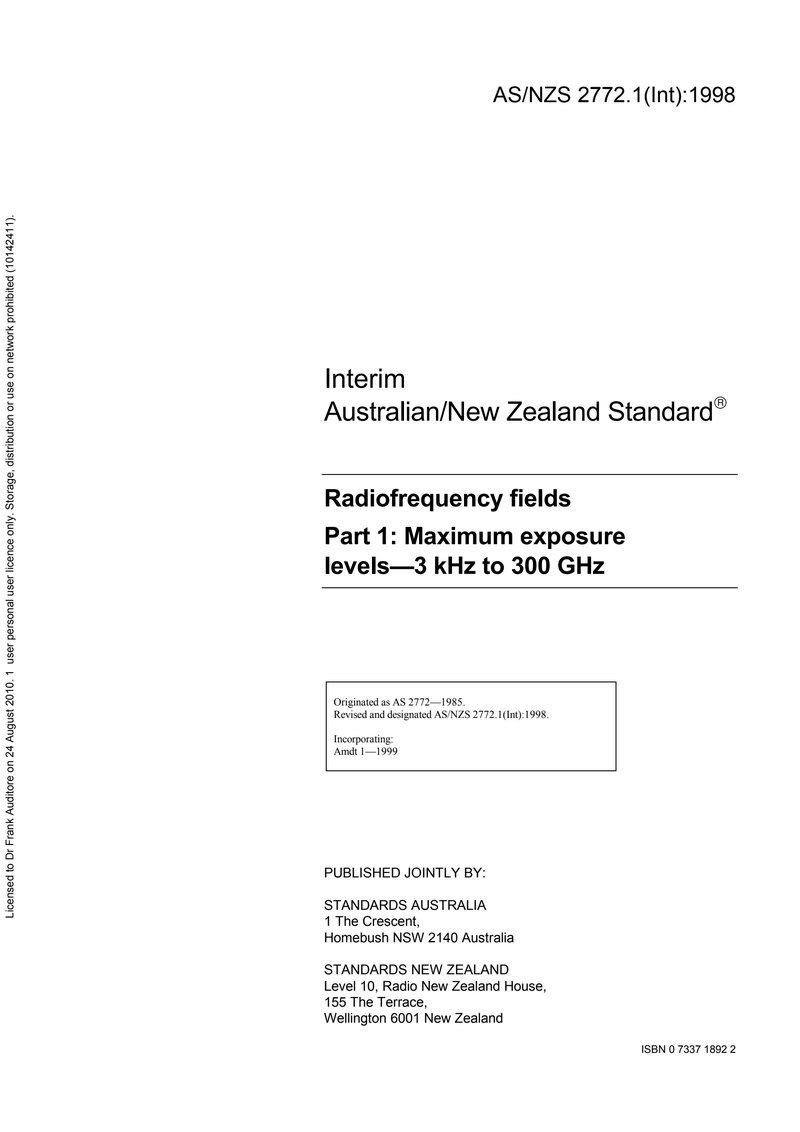
Interim Australian/New Zealand Standard®
AS/NZS 2772.1(Int):1998
Radiofrequency fields
Part 1: Maximum exposure levels—3 kHz to 300 GHz
|
Originated as AS 2772—1985. Revised and designated AS/NZS 2772.1(Int):1998. Incorporating: Amdt 1—1999 |
PUBLISHED JOINTLY BY:
STANDARDS AUSTRALIA
1 The Crescent,
Homebush NSW 2140 Australia
STANDARDS NEW ZEALAND
Level 10, Radio New Zealand House,
155 The Terrace,
Wellington 6001 New Zealand
ISBN 0 7337 1892 2
4
PREFACE
This Interim Standard was prepared by the Joint Standards Australia/Standards New Zealand Committee TE/7, Human Exposure to Electromagnetic Fields, to supersede, in Australia, AS 2772.1—1990 and, in New Zealand, NZS 6609.1:1990, Radiofrequency radiation, Part 1: Maximum exposure levels—100 kHz to 300 GHz.
This Interim Standard is based on the International Radiation Protection Association (IRPA) Specific Absorption Rate (SAR) Guidelines. This edition covers an extended frequency range down to 3 kHz.
The term 'informative' has been used in this Interim Standard to defined the application of the appendix to which it applies. An informative appendix is for information and guidance only.
While this document has been the subject of public comment and has met the consensus requirements for publication, given the level of public interest in this subject Standards Australia and Standards New Zealand has decided to issue this document as an Interim Standard to allow further committee review and public comment before being finalised. The particular areas the Committee will be reviewing are as follows:
- The treatment of non-thermal effects.
- The appropriateness of proposed radiation levels which are based on current World Heath Organization (WHO) recommendations.
- The proposed measurement methods of time and spatial averaging.
Standards Australia and Standards New Zealand invite comment on this Interim Standard from persons and organizations concerned with this subject. The date for expiry of comment is 5 March 1999 at which (or earlier) this Interim Standard will be confirmed, withdrawn or revised in the light of comments received.
During the life of this document the Committee will monitor all comment as it is received.
Attention is drawn to the fact that this document is an Interim Australian/ New Zealand Standard and should be regarded as a development Standard liable to future alteration.
© Copyright—STANDARDS AUSTRALIA/STANDARDS NEW ZEALAND
Users of Standards are reminded that copyright subsists in all Standards Australia and Standards New Zealand publications and software. Except where the Copyright Act allows and except where provided for below no publications or software produced by Standards Australia or Standards New Zealand may be reproduced, stored in a retrieval system in any form or transmitted by any means without prior permission in writing from Standards Australia or Standards New Zealand. Permission may be conditional on an appropriate royalty payment. Australian requests for permission and information on commercial software royalties should be directed to the head office of Standards Australia. New Zealand requests should be directed to Standards New Zealand.
Up to 10 percent of the technical content pages of a Standard may be copied for use exclusively in-house by purchasers of the Standard without payment of a royalty or advice to Standards Australia or Standards New Zealand.
Inclusion of copyright material in computer software programs is also permitted without royalty payment provided such programs are used exclusively in-house by the creators of the programs.
Care should be taken to ensure that material used is from the current edition of the Standard and that it is updated whenever the Standard is amended or revised. The number and date of the Standard should therefore be clearly identified.
The use of material in print form or in computer software programs to be used commercially, with or without payment, or in commercial contracts is subject to the payment of a royalty. This policy may be varied by Standards Australia or Standards New Zealand at any time.
5
CONTENTS
| Page | ||
|---|---|---|
| FOREWORD | 4 | |
| 1 | SCOPE | 6 |
| 2 | APPLICATION | 6 |
| 3 | REFERENCED DOCUMENTS | 7 |
| 4 | DEFINITIONS AND UNITS | 7 |
| 5 | EXPOSURE LIMITS—OCCUPATIONAL | 9 |
| 6 | EXPOSURE LIMITS—NON-OCCUPATIONAL | 13 |
| 7 | VERIFICATION OF COMPLIANCE WITH THE STANDARD | 15 |
| 8 | PROTECTION—OCCUPATIONAL EXPOSURE | 19 |
| 9 | PROTECTION—NON-OCCUPATIONAL EXPOSURE | 21 |
| APPENDICES | ||
| A | RATIONALE FOR THE DEVELOPMENT OF THE MAXIMUM EXPOSURE LEVELS FOR RF RADIATION | 22 |
| B | MEDICAL MONITORING | 27 |
6
预览内容由文件识别整理,表格、公式及文字请以原始文件为准。
原文图片预览
PAGE IMAGES
下载标准文件
AS NZS 2772.1(Int)-1998 Radiofrequency fields - Ma
英语 · PDF · 6 页 · 323.58 KB