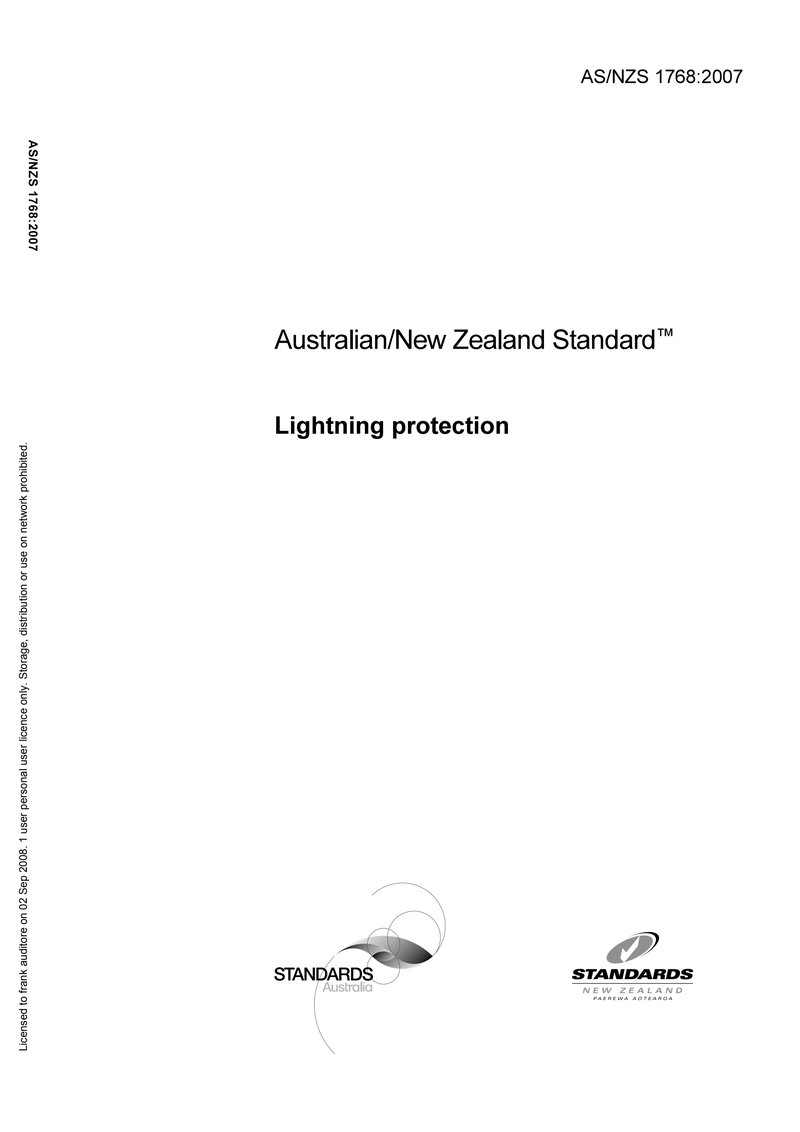
AS NZS 1768-2007 Lightning protection
雷电防护
AS NZS 1768-2007 Lightning protection
Lightning protection
标准信息
STANDARD INFORMATION- 标准编号
- AS NZS 1768-2007 Lightning protection
- 所属分类
- AS 澳大利亚标准
- 发布机构
- Standards Australia/Standards New Zealand
- 版本年份
- 2007
- 文件语言
- 英语
- 文件格式
- 文件页数
- 6 页
- 文件大小
- 3.94 MB
中文名称为参考译名,文件语言以原文为准。
· 更新:
标准简介
OVERVIEW中文简介
该标准提供广泛结构和系统的雷电防护原则与实践指导。它涵盖雷电风险评估与管理、人身安全、建筑物防护以及建筑物内人员和设备的防护。
English summary
This standard provides authoritative guidance on the principles and practices of lightning protection for a wide range of structures and systems. It covers lightning risk assessment and management, personal safety, protection of structures, and protection of persons and equipment within buildings.
以上为根据文件整理的内容简介。
相关标签
标准内容预览
DOCUMENT PREVIEWCONTENTS
| Page | |
|---|---|
| SECTION 1 SCOPE AND GENERAL | |
| 1.1 SCOPE | 5 |
| 1.2 APPLICATION | 5 |
| 1.3 INTRODUCTION | 5 |
| 1.4 REFERENCED DOCUMENTS | 6 |
| 1.5 DEFINITIONS | 6 |
| SECTION 2 ASSESSMENT AND MANAGEMENT OF RISK DUE TO LIGHTNING — ANALYSIS OF NEED FOR PROTECTION | |
| 2.1 INTRODUCTION | 11 |
| 2.2 SCOPE OF SECTION | 11 |
| 2.3 CONCEPT OF RISK | 12 |
| 2.4 DAMAGE DUE TO LIGHTNING | 13 |
| 2.5 RISKS DUE TO LIGHTNING | 17 |
| 2.6 PROCEDURE FOR RISK ASSESSMENT AND MANAGEMENT | 21 |
| 2.7 RISK MANAGEMENT CALCULATION TOOL | 23 |
| SECTION 3 PRECAUTIONS FOR PERSONAL SAFETY | |
| 3.1 SCOPE OF SECTION | 28 |
| 3.2 NEED FOR PERSONAL PROTECTION | 28 |
| 3.3 PERSONAL CONDUCT | 29 |
| 3.4 EFFECT ON PERSONS AND TREATMENT FOR INJURY BY LIGHTNING | 31 |
| SECTION 4 PROTECTION OF STRUCTURES | |
| 4.1 SCOPE OF SECTION | 32 |
| 4.2 PROTECTION LEVEL | 32 |
| 4.3 LPS DESIGN RULES | 32 |
| 4.4 ZONES OF PROTECTION FOR LIGHTING INTERCEPTION | 34 |
| 4.5 METHODS OF PROTECTION | 42 |
| 4.6 MATTERS TO BE CONSIDERED WHEN PLANNING PROTECTION | 44 |
| 4.7 MATERIALS | 47 |
| 4.8 FORM AND SIZE OF CONDUCTORS | 51 |
| 4.9 JOINTS | 52 |
| 4.10 FASTENERS | 52 |
| 4.11 AIR TERMINALS | 53 |
| 4.12 DOWNCONDUCTORS | 55 |
| 4.13 TEST LINKS | 58 |
| 4.14 EARTH TERMINATIONS | 58 |
| 4.15 EARTHING ELECTRODES | 59 |
| 4.16 METAL IN AND ON A STRUCTURE | 61 |
| SECTION 5 PROTECTION OF PERSONS AND EQUIPMENT WITHIN BUILDINGS | |
| 5.1 SCOPE OF SECTION | 66 |
| 5.2 NEED FOR PROTECTION | 66 |
| 5.3 MODES OF ENTRY OF LIGHTNING IMPULSES | 66 |
| 5.4 GENERAL CONSIDERATIONS FOR PROTECTION | 69 |
| 5.5 PROTECTION OF PERSONS WITHIN BUILDINGS | 70 |
| 5.6 PROTECTION OF EQUIPMENT | 73 |
6
Australian/New Zealand Standard™
Lightning protection
2
AS/NZS 1768:2007
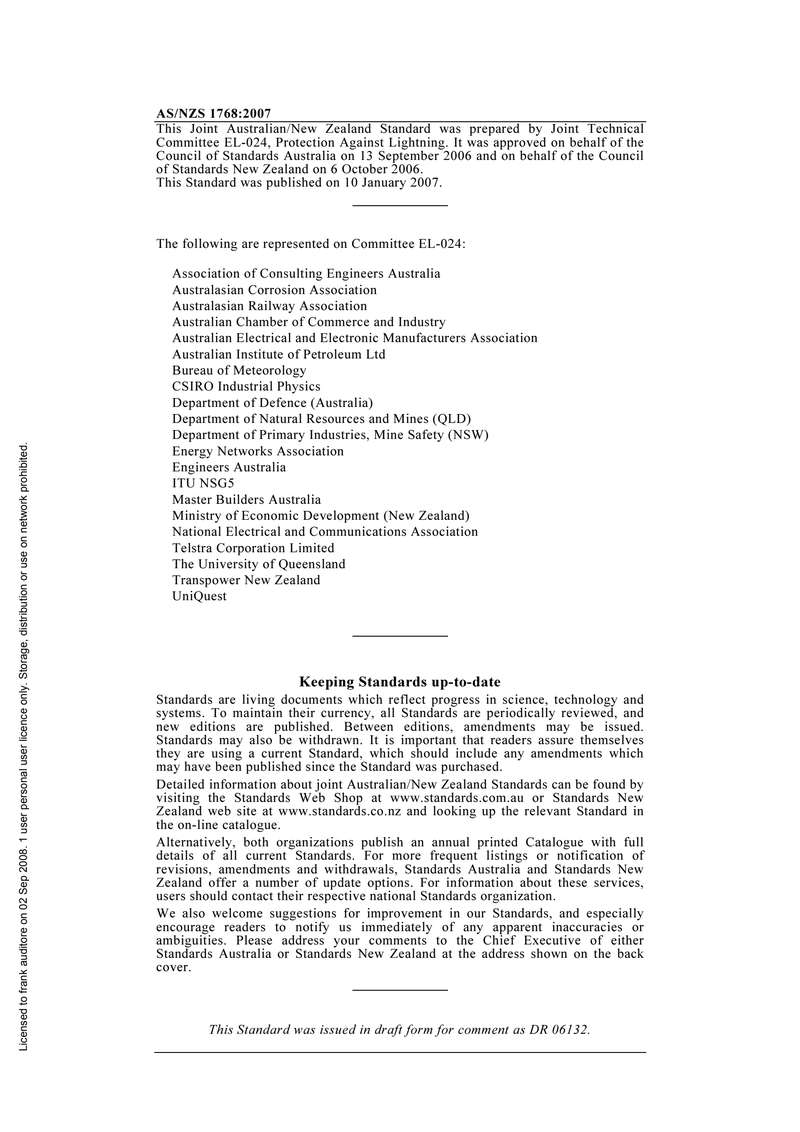
This Joint Australian/New Zealand Standard was prepared by Joint Technical Committee EL-024, Protection Against Lightning. It was approved on behalf of the Council of Standards Australia on 13 September 2006 and on behalf of the Council of Standards New Zealand on 6 October 2006. This Standard was published on 10 January 2007.
The following are represented on Committee EL-024:
Association of Consulting Engineers Australia
Australasian Corrosion Association
Australasian Railway Association
Australian Chamber of Commerce and Industry
Australian Electrical and Electronic Manufacturers Association
Australian Institute of Petroleum Ltd
Bureau of Meteorology
CSIRO Industrial Physics
Department of Defence (Australia)
Department of Natural Resources and Mines (QLD)
Department of Primary Industries, Mine Safety (NSW)
Energy Networks Association
Engineers Australia
ITU NSG5
Master Builders Australia
Ministry of Economic Development (New Zealand)
National Electrical and Communications Association
Telstra Corporation Limited
The University of Queensland
Transpower New Zealand
UniQuest
Keeping Standards up-to-date
Standards are living documents which reflect progress in science, technology and systems. To maintain their currency, all Standards are periodically reviewed, and new editions are published. Between editions, amendments may be issued. Standards may also be withdrawn. It is important that readers assure themselves they are using a current Standard, which should include any amendments which may have been published since the Standard was purchased.
Detailed information about joint Australian/New Zealand Standards can be found by visiting the Standards Web Shop at www.standards.com.au or Standards New Zealand web site at www.standards.co.nz and looking up the relevant Standard in the on-line catalogue.
Alternatively, both organizations publish an annual printed Catalogue with full details of all current Standards. For more frequent listings or notification of revisions, amendments and withdrawals, Standards Australia and Standards New Zealand offer a number of update options. For information about these services, users should contact their respective national Standards organization.
We also welcome suggestions for improvement in our Standards, and especially encourage readers to notify us immediately of any apparent inaccuracies or ambiguities. Please address your comments to the Chief Executive of either Standards Australia or Standards New Zealand at the address shown on the back cover.
This Standard was issued in draft form for comment as DR 06132.
3
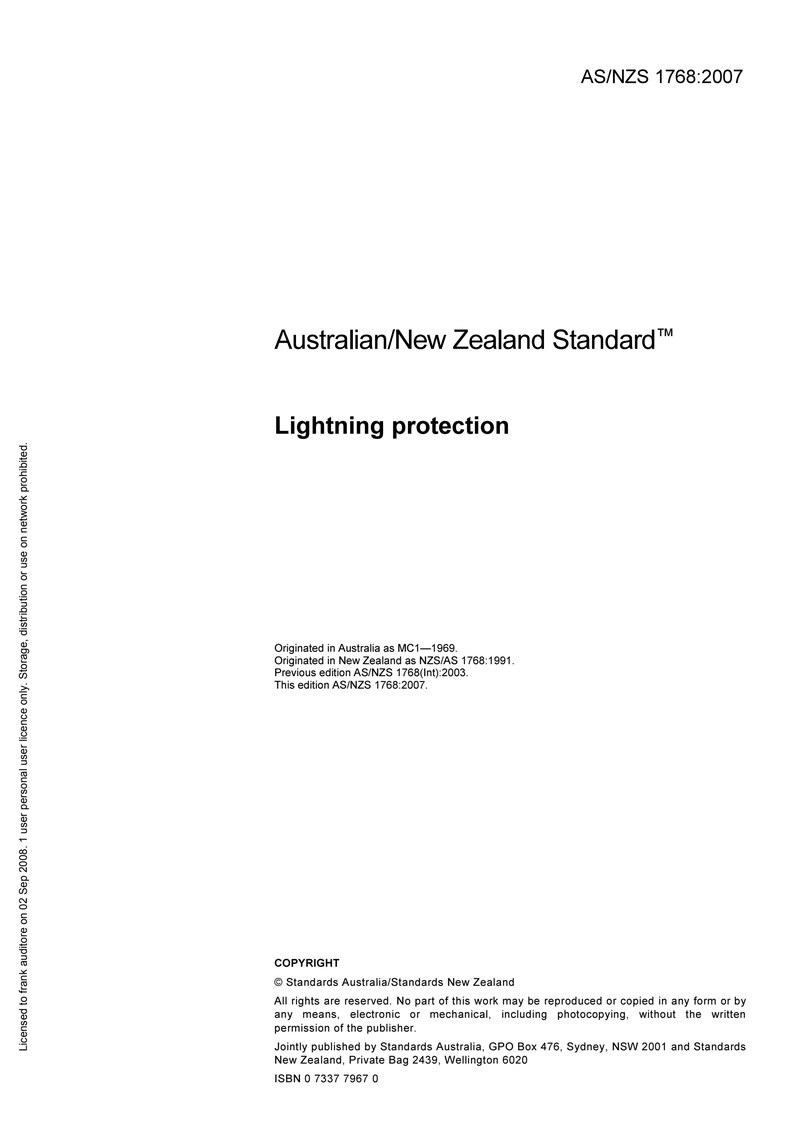
Australian/New Zealand Standard™
AS/NZS 1768:2007
Lightning protection
Originated in Australia as MC1—1969.
Originated in New Zealand as NZS/AS 1768:1991.
Previous edition AS/NZS 1768(Int):2003.
This edition AS/NZS 1768:2007.
COPYRIGHT
© Standards Australia/Standards New Zealand
All rights are reserved. No part of this work may be reproduced or copied in any form or by any means, electronic or mechanical, including photocopying, without the written permission of the publisher.
Jointly published by Standards Australia, GPO Box 476, Sydney, NSW 2001 and Standards New Zealand, Private Bag 2439, Wellington 6020
ISBN 0 7337 7967 0
4
PREFACE
This Standard was prepared by the Joint Standards Australia/Standards New Zealand Committee EL-024, Protection against Lightning, to supersede AS/NZS 1768(Int):2003, Lightning protection.
This Standard is intended to provide authoritative guidance on the principles and practices of lightning protection for a wide range of structures and systems. It is not intended for mandatory application but, if called up in a contractual situation, compliance with this Standard requires compliance with all relevant clauses of the Standard such that the level of protection will be sufficient to achieve a tolerable level of risk as determined by the risk calculation.
In general, it is not economically possible to provide total protection against all the possible damaging effects of lightning, but the recommendations in this Standard will reduce the probability of damage to a calculated acceptable level, and will minimize any lightning damage that does occur. Guidance is given on methods of enhancing the level of protection against lightning damage, if this is required in a particular situation.
Where a new structure is to be erected, the matter of lightning protection should be considered in the planning stage, as the necessary measures can often be affected in the architectural features without detracting from the appearance of the building. In addition to the aesthetic considerations, it is usually less expensive to install a lightning protection system during construction than afterwards.
The decision to provide lightning protection may be taken without carrying out a risk assessment or regardless of the outcome of any risk assessment, for example, where there is a desire that there be no avoidable risk. Any decision not to provide lightning protection should only be made after considering the advice provided in this Standard. Where doubt exists as to the need for lightning protection, further advice should be sought from a lightning protection designer or installer.
Unless it has been specified that lightning protection must be provided, the first decision to make is whether the lightning protection is needed. Section 2 provides guidance to assist in this decision. Section 3 provides advice on the protection of persons from lightning, mainly relating to the behaviour of persons when not inside substantial buildings. Once a decision is made that lightning protection is necessary, Section 4 provides details on interception lightning protection for the building or structure. This includes information on the size, material, and form of conductors, the positioning of air terminals and downconductors, and the requirements for earth terminations. Persons and equipment within buildings can be at risk from the indirect effects of lightning and Section 5 gives recommendations for the protection of persons and equipment within buildings from the effects of lightning.
Section 6 describes methods of lightning protection of various items not covered in earlier sections, such as communications antennas, chimneys, boats, fences, and trees. A clause is included on methods for protecting domestic dwellings and assorted structures in public places, where a complete protection system may not be justified, but some protection is considered desirable.
Section 7 sets out recommendations for the protection of structures with explosive or highly-flammable contents. Section 8 gives advice on precautions to be taken during installation, inspecting, testing, and maintaining lightning protection systems.
A number of appendices are included that provide additional information and advice. The appendices form an integral part of this Standard unless specifically stated otherwise. i.e. appendices identified as 'informative' only provide supportive or background information and are therefore not an integral part of this Standard.
5
CONTENTS
| Page | |
|---|---|
| SECTION 1 SCOPE AND GENERAL | |
| 1.1 SCOPE | 5 |
| 1.2 APPLICATION | 5 |
| 1.3 INTRODUCTION | 5 |
| 1.4 REFERENCED DOCUMENTS | 6 |
| 1.5 DEFINITIONS | 6 |
| SECTION 2 ASSESSMENT AND MANAGEMENT OF RISK DUE TO LIGHTNING — ANALYSIS OF NEED FOR PROTECTION | |
| 2.1 INTRODUCTION | 11 |
| 2.2 SCOPE OF SECTION | 11 |
| 2.3 CONCEPT OF RISK | 12 |
| 2.4 DAMAGE DUE TO LIGHTNING | 13 |
| 2.5 RISKS DUE TO LIGHTNING | 17 |
| 2.6 PROCEDURE FOR RISK ASSESSMENT AND MANAGEMENT | 21 |
| 2.7 RISK MANAGEMENT CALCULATION TOOL | 23 |
| SECTION 3 PRECAUTIONS FOR PERSONAL SAFETY | |
| 3.1 SCOPE OF SECTION | 28 |
| 3.2 NEED FOR PERSONAL PROTECTION | 28 |
| 3.3 PERSONAL CONDUCT | 29 |
| 3.4 EFFECT ON PERSONS AND TREATMENT FOR INJURY BY LIGHTNING | 31 |
| SECTION 4 PROTECTION OF STRUCTURES | |
| 4.1 SCOPE OF SECTION | 32 |
| 4.2 PROTECTION LEVEL | 32 |
| 4.3 LPS DESIGN RULES | 32 |
| 4.4 ZONES OF PROTECTION FOR LIGHTING INTERCEPTION | 34 |
| 4.5 METHODS OF PROTECTION | 42 |
| 4.6 MATTERS TO BE CONSIDERED WHEN PLANNING PROTECTION | 44 |
| 4.7 MATERIALS | 47 |
| 4.8 FORM AND SIZE OF CONDUCTORS | 51 |
| 4.9 JOINTS | 52 |
| 4.10 FASTENERS | 52 |
| 4.11 AIR TERMINALS | 53 |
| 4.12 DOWNCONDUCTORS | 55 |
| 4.13 TEST LINKS | 58 |
| 4.14 EARTH TERMINATIONS | 58 |
| 4.15 EARTHING ELECTRODES | 59 |
| 4.16 METAL IN AND ON A STRUCTURE | 61 |
| SECTION 5 PROTECTION OF PERSONS AND EQUIPMENT WITHIN BUILDINGS | |
| 5.1 SCOPE OF SECTION | 66 |
| 5.2 NEED FOR PROTECTION | 66 |
| 5.3 MODES OF ENTRY OF LIGHTNING IMPULSES | 66 |
| 5.4 GENERAL CONSIDERATIONS FOR PROTECTION | 69 |
| 5.5 PROTECTION OF PERSONS WITHIN BUILDINGS | 70 |
| 5.6 PROTECTION OF EQUIPMENT | 73 |
6
预览内容由文件识别整理,表格、公式及文字请以原始文件为准。
原文图片预览
PAGE IMAGES
下载标准文件
AS NZS 1768-2007 Lightning protection
英语 · PDF · 6 页 · 3.94 MB